

In February 2026, R&T Deposit Solutions surveyed 200 senior Banking-as-a-Service (BaaS), or sponsor banking and FinTech executives, asking how they compete for deposits.
Three in four said access to expanded FDIC deposit insurance coverage is highly important to winning and retaining deposits: 74% of BaaS executives and 78% of FinTech leaders (R&T Deposit Solutions, 2026 BaaS / FinTech Survey Report).
For most of the past decade, banks competed on rates, convenience, and brand, and deposit insurance stayed in the background as a compliance requirement. The survey shows it has moved to the front line of customer acquisition. Deposit safety has become a selling point.
The institutions pulling ahead can prove deposit safety, not just claim it. At R&T, we call the advantage they earn the “trust dividend” – the competitive edge an institution gains when it can show customers, partners, and regulators that deposits are protected, transparent, and resilient.
One Problem, Two Audiences
What makes the trust dividend especially powerful is that it addresses a shared challenge across two distinct but interconnected audiences: partner banking leaders and community bank executives.
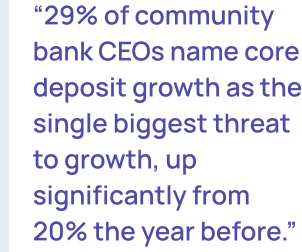
BaaS sponsor banks and their FinTech partners face fast growth and intense regulatory scrutiny. Community banks are working on an older problem that has not eased: growing core deposits. According to the American Bankers Association (ABA) Community Bank CEO Priorities for 2026 report, 72% of community bank CEOs say core deposit growth keeps them up at night, and 29% name it as the single biggest threat to growth, up significantly from 20% the year before.
The operating models differ, but the underlying problem is the same: how to attract and retain stable, trusted deposits in an increasingly competitive and uncertain environment. The trust dividend provides a unifying answer. Whether digital-first or relationship-driven, institutions that can deliver verifiable deposit protection and transparency gain a meaningful edge.
Trust as a Growth Engine in BaaS
For BaaS sponsor banks and their FinTech partners, trust is not just a reputational asset. It is a growth engine.
In partner banking, the whole model runs on confidence. Sponsor banks, FinTechs, end customers, and regulators all depend on a clear view of how deposits are structured and protected. When that confidence is strong, growth accelerates. When it is weak, friction emerges.
The infrastructure behind that confidence has become the standard. 96% of BaaS executives have already adopted a deposit insurance platform, and 86% say it differentiates their business (source: R&T 2026 BaaS / FinTech Survey). The platform is what turns a promise of safety into something a customer can see. It lets an institution:
The Role of Expanded FDIC Deposit Insurance Coverage
At the center of the trust dividend is access to expanded FDIC deposit insurance coverage.
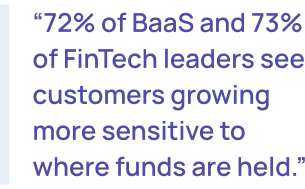
Customers are watching where their money sits more closely than they used to, and most executives expect this to intensify: 72% of BaaS and 73% of FinTech leaders see customers growing more sensitive to where funds are held (R&T 2026 BaaS / FinTech Survey). On what actually earns their trust, the survey was unanimous: all 200 respondents agreed that verifiable access to FDIC deposit insurance protection is critical (source: R&T 2026 BaaS / FinTech Survey).
Access to expanded deposit insurance coverage moves protection out of the back office and into the sales conversation. It gives an institution a credible answer to the depositor’s first question: how much of this is actually protected? For FinTechs, that answer matters most. In a crowded field of digital accounts that look alike, the ability to offer access to expanded deposit protection through a sponsor bank relationship can be the feature that wins the customer.
Delivering the Trust Dividend
This is where the Demand Deposit Marketplace® (DDM®) program fits in. Through a network of participating banks, the DDM program lets institutions send, receive, and reciprocate deposits, giving customers access to expanded FDIC deposit insurance coverage across multiple banks through a single account relationship.
That structure lets an institution scale deposits and demonstrate protection at the same time. As regulators demand greater visibility and customers ask harder questions, the DDM program gives both a clear record of how and where funds are protected.
Capturing the Trust Dividend
For leaders across banking, FinTech, and partner banking networks, three priorities stand out:
-
1
Make deposit safety visible.
Customers and partners expect clear, accessible proof of protection, not assurances.
-
2
Invest in infrastructure.
Scalable, transparent deposit platforms are now foundational to growth.
-
3
Build trust into the product experience.
Access to expanded FDIC deposit insurance coverage should be part of how an offering is designed and presented, not a disclosure buried at the end.
Rates can be matched and features copied. Verifiable deposit protection, built on infrastructure and earned over time, is harder to replicate.
Across the survey, executives point to the same conclusion: in partner banking, the ability to demonstrate deposit safety is becoming the basis on which deposits are won.
Sources:
R&T Deposit Solutions, 2026 BaaS / FinTech Survey Report (May 2026).
American Bankers Association, Community Bank CEO Priorities for 2026.