
Skip to content
The Trust Dividend in Partner Banking
R&T Logo, Blue
  • Solutions
    • DDM®
    • CDMX℠
    • RTID®
    • Funding
  • Who We Serve
    • Depository Institutions
    • BaaS Banks
    • FinTechs
    • Trust Companies
    • Broker-Dealers
  • About R&T
    • Why R&T
    • Events
    • Testimonials
    • Leadership Team
    • Receiving Institution Lists
  • Technology
  • Resources
    • News & Insights
    • Collateral
    • Videos
    • Use Cases
    • Podcasts & Webinars
Contact Us
Contact Us
  • Solutions
    • DDM®
    • CDMX℠
    • RTID®
    • Funding
  • Who We Serve
    • Depository Institutions
    • BaaS Banks
    • FinTechs
    • Trust Companies
    • Broker-Dealers
  • About R&T
    • Why R&T
    • Events
    • Testimonials
    • Leadership Team
    • Receiving Institution Lists
  • Technology
  • Resources
    • News & Insights
    • Collateral
    • Videos
    • Use Cases
    • Podcasts & Webinars
Contact Us
Back to News & Insights

What the Recent FDIC Report Means for Modern Cash Management

July 21, 2026

The banking turmoil of spring 2023 is often discussed through the lens of uninsured deposits. That framing is important, but it is incomplete. The Federal Deposit Insurance Corporation’s (FDIC) May 2026 staff study, Dissecting Depositor Flight: An Analysis of the Spring 2023 Bank Failures, adds a more nuanced take for finance leaders: depositor behavior is shaped not only by insurance status, but also by depositor size, concentration, and speed of access to funds.

The study suggests that in a digital banking environment, large depositors are often positioned to move first and fastest. That makes cash placement strategy a core part of treasury resilience rather than an administrative decision about where excess funds sit.

For cash-intensive businesses, risk is defined by balance sheet exposure at a bank as well as the concentration levels of deposits, how quickly those deposits can leave, and whether an organization has built a framework for diversification, liquidity access, and coverage optimization.

What the FDIC Report Found

The FDIC’s analysis examined deposit flows at Silicon Valley Bank, Signature Bank, and First Republic Bank using transaction-level data from core deposit and wire systems. Its findings showed that fully insured retail depositors generally did not run, and in some cases, their balances increased during the stress period. But the study also found that insurance coverage alone did not explain depositor behavior. The largest depositors were more likely to run even after accounting for insurance status.

Concentration and Speed Changed the Equation
“Uninsured balances represented about 94% of deposits at Silicon Valley Bank, 76% at Signature Bank, and 74% at First Republic Bank.”

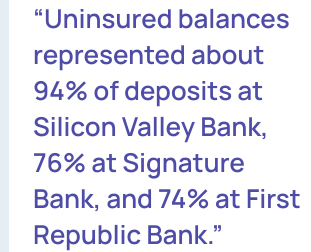
The numbers in the report are striking. Uninsured balances represented about 94% of deposits at Silicon Valley Bank, 76% at Signature Bank, and 74% at First Republic Bank. At the same time, deposits were highly concentrated among a very small number of large customers. In other words, these were not simply banks with high levels of uninsured balances. They were banks where a handful of large depositors had an outsized influence on funding stability.

The pace of the runs highlights why this matters for treasury strategy. Between March 7 and March 17, 2023, Silicon Valley Bank and Signature Bank each lost more than half of their deposits. First Republic Bank reported a smaller decline during that period, but excluding the temporary cash infusion from the banking industry, the FDIC found it would have lost nearly 54% of deposits. Much of the outflow took place within three business days, with daily outflows exceeding 20% of deposits, and most funds left through wire channels such as Fedwire and SWIFT. In a digital environment, concentration risk can become liquidity stress with very little warning.

Why This Matters for Finance Leaders

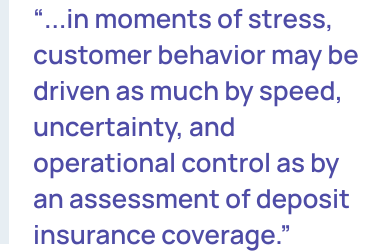
One of the most important takeaways from the FDIC study is that in moments of stress, customer behavior may be driven as much by speed, uncertainty, and operational control as by an assessment of deposit insurance coverage.
“...in moments of stress, customer behavior may be driven as much by speed, uncertainty, and operational control as by an assessment of deposit insurance coverage.”

For CFOs, treasurers, and finance teams, the question moves beyond whether balances are insured on paper, to whether the organization has a cash strategy designed around modern money movement. 

Our current landscape allows for large balances to move instantly. High concentrations can amplify risk, and access to liquidity may matter as much as coverage limits. Businesses should be asking where funds are held, how concentrated they are within each institution, what portion is operational versus strategic cash, and whether current account structures support both resilience and day-to-day usability.

The Role of Cash Sweep Solutions

A well-structured cash sweep program can help organizations allocate their cash balances across multiple banks, reducing deposit concentration at any single bank while providing the organization with enhanced access to deposit insurance coverage on their funds. Just as important, sweep strategies can support operational simplicity by allowing businesses to manage liquidity more efficiently without manually fragmenting their cash position across numerous standalone bank accounts.

As evidenced by the FDIC study, businesses benefit from thinking proactively about diversification, liquidity, account structure, and contingency planning. A sweep strategy can be a practical component of that framework, especially for firms that routinely maintain balances above standard FDIC insurance thresholds.


Preparing for Times of Bank Stress

The clearest lesson from the FDIC’s May 2026 analysis is that modern bank run risk is a question of behavior as much as deposit insurance coverage. Fully insured retail balances remained relatively stable. Large, concentrated depositors were far more likely to move quickly, often across entire account relationships. For companies managing significant cash balances, that makes resilient cash allocation a strategic issue.

Thoughtful cash management recognizes how quickly conditions can change and makes sure liquidity structures are built to respond. For finance leaders, now is the time to evaluate uninsured cash exposure, bank concentration, and whether tools such as sweep solutions can strengthen resilience without sacrificing operational flexibility.

Previous

Media Contact

Melissa Kaiser
Director, Marketing

  • 1-212-830-5242
  • mkaiser@rnt.com

Don’t Miss Out on the Latest Insights.

Follow us on: image/svg+xml

Interested?

Learn how we can help you attract, grow & retain more deposits.

Contact Us

You are now leaving rnt.com

Stay on site

OR

Click to Continue
R&T Logo, White
aba partner network premiere
great place to work certified badge
  • 1-866-237-2752
  • info@rnt.com
  • 1370 Broadway, 17th Floor
    New York, NY 10018-7302
  • LinkedIn
  • Solutions
    • DDM®
    • CDMX℠
    • RTID®
    • Funding
  • Who We Serve
    • Depository Institutions
    • BaaS Banks
    • FinTechs
    • Trust Companies
    • Broker-Dealers
  • About R&T
    • Why R&T
    • Events
    • Testimonials
    • Leadership Team
    • Receiving Institution Lists
  • Technology
  • Resources
    • News & Insights
    • Collateral
    • Videos
    • Use Cases
    • Podcasts & Webinars

R&T Deposit Networks, LLC, R&T Deposit Marketplace, LLC, R&T Deposit Solutions, LLC and R&T Deposit Programs, LLC (each d/b/a R&T Deposit Solutions), each a Delaware limited liability company, (together, “R&T”) provide administrative, recordkeeping, and/or other services to banks, credit unions, trust companies, wealth management firms, broker-dealers and other institutions with respect to deposit placement and sweep programs, including the Demand Deposit Marketplace® (DDM®), Certificate of Deposit Marketplace Exchange℠ (CDMX℠) and R&T Insured Deposits℠ (RTID®) programs, as well as other services. An affiliate of R&T, Stable Custody Group II LLC (“Stable”), acts as agent of participating sending institutions under the DDM and CDMX programs.  R&T and Stable, together, “we”, “us” or “our”.  All of our services are provided subject to the terms and conditions of the written agreements and/or agency appointments between us and our clients with respect to those services, and we provide no representations or warranties, express or implied, except as expressly set forth in those written agreements and/or appointments. Click here for our legal and other disclosures. We are not an FDIC or NCUA-insured institution. FDIC insurance only covers the failure of an FDIC-insured institution. NCUA insurance only covers the failure of an NCUA-insured institution.  Certain conditions must be satisfied for FDIC and NCUA pass-through deposit insurance coverage to apply. Click here for a list of the FDIC and NCUA-insured institutions with which R&T has a direct or indirect business relationship for the placement of deposits under the DDM, CDMX, and RTID programs, and into which a participating institution may place deposits (subject to the terms of those programs and any opt-outs by the participating institution and/or its customers).  While the DDM, CDMX, and RTID programs provide access to an expanded level of FDIC or NCUA deposit insurance coverage on funds placed into the programs (subject to program terms and applicable laws, regulations and guidance, including pass-through insurance coverage requirements), the DDM, CDMX and RTID programs, themselves, as well as our other service offerings, are not insured or guaranteed by the FDIC or NCUA, are not deposits, and may lose value. We are not an affiliate of an FDIC or NCUA-insured institution, we are not an office, division, or sub-division of the FDIC or NCUA, and we are not associated with the FDIC or NCUA or office, division, or sub-division thereof. The primary objective of the DDM, CDMX, and RTID programs is to provide customers with convenient access to expanded deposit insurance coverage on their funds (and not for investment enhancements, higher rates of returns or profits). R&T®, Reich & Tang®, Demand Deposit Marketplace®, DDM®, DepositView® and RTID® are registered marks of R&T Deposit Networks, LLC. CDMX℠ is a pending mark of R&T Deposit Networks, LLC. IDEA℠ , Certificate of Deposit Marketplace Exchange℠ , R&T Insured Deposits℠ and R&T Connect℠ are unregistered service marks of R&T Deposit Networks, LLC.

© 2026 R&T Deposit Networks, LLC

  • Privacy Policy
  • Privacy Policy – CA
  • Terms of Use
  • Legal Disclosures
  • Receiving Institution Lists
  • DDM Program Limit
  • Do Not Share My Personal Information
  • Cookies