

Skip to content
Why Community Banking Matters, and How R&T Helps Strengthen It
R&T Logo, Blue
  • Solutions
    • DDM®
    • CDMX℠
    • RTID®
    • Funding
  • Who We Serve
    • Depository Institutions
    • BaaS Banks
    • FinTechs
    • Trust Companies
    • Broker-Dealers
  • About R&T
    • Why R&T
    • Events
    • Testimonials
    • Leadership Team
    • Receiving Institution Lists
  • Technology
  • Resources
    • News & Insights
    • Collateral
    • Videos
    • Use Cases
    • Podcasts & Webinars
Contact Us
Contact Us
  • Solutions
    • DDM®
    • CDMX℠
    • RTID®
    • Funding
  • Who We Serve
    • Depository Institutions
    • BaaS Banks
    • FinTechs
    • Trust Companies
    • Broker-Dealers
  • About R&T
    • Why R&T
    • Events
    • Testimonials
    • Leadership Team
    • Receiving Institution Lists
  • Technology
  • Resources
    • News & Insights
    • Collateral
    • Videos
    • Use Cases
    • Podcasts & Webinars
Contact Us
Back to News & Insights

The Rise of Reciprocal Deposits: Strengthening Core Funding for Community Banks

November 17, 2025

As banks continue to evolve their funding strategies, a notable shift is reshaping how financial institutions approach them. Reciprocal deposits, once a niche tool, have surged to the forefront of core deposit management, particularly for community banks seeking stable and flexible funding sources.

A Dramatic Surge in Adoption

The numbers tell a compelling story. Total reciprocal deposits have nearly tripled, skyrocketing from approximately $156 billion in December 2022 to an impressive $440 billion by September 2025 (based on FFIEC call reports). The number of participating banks also climbed from around 1,523 to 2,105 over this period. This remarkable growth underscores the intensifying competition for core deposits and the industry’s drive for reliable funding alternatives.
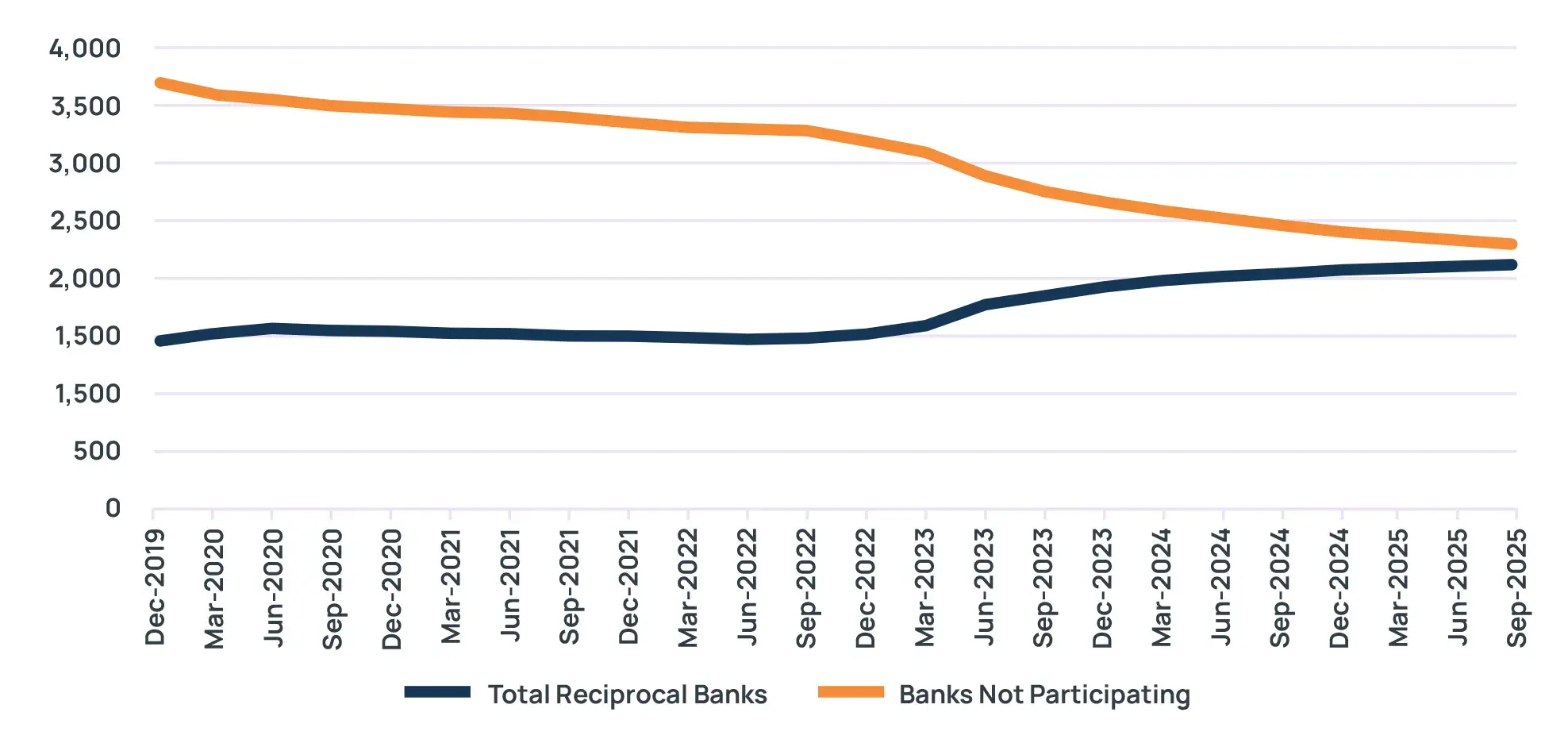
Line chart comparing Total Reciprocal Banks (dark blue line) versus Banks Not Participating (orange line) from December 2019 to September 2025. The total reciprocal banks line increases from approximately 1,500 to 2,100, while banks not participating decreases from approximately 3,700 to 2,300, with the lines converging toward equal levels by September 2025.

The Changing Face of Core Deposits

Community banks and other small financial institutions can leverage the power of reciprocal deposits to even the playing field with the larger banks. These community banks face intense competition from larger institutions and constant pressure to manage overhead costs, while mitigating deposit flight risks. Reciprocal deposits present a solution, giving community banks the ability to offer access to expanded FDIC-insurance on funds in order to capture large balance accounts, providing a strategic advantage in a crowded market.

Why Reciprocal Deposits Are Gaining Ground
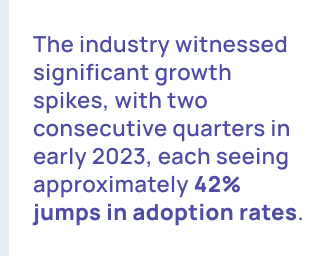
The industry witnessed significant growrth spikes, with two consecutive quarters in early 2023, each seeing approximately 42% jumps in adoption rates.

Regulatory Recognition and Investor Confidence

More explicit regulatory guidelines have paved the way for broader acceptance of reciprocal deposits. The industry witnessed significant growth spikes, with two consecutive quarters in early 2023, each seeing approximately 42% jumps in adoption rates. Subsequent quarters continued to show steady rises, cementing reciprocal deposits as a mainstream funding strategy. This shift is also evident in the decreasing number of non-participating banks, which fell from 3,201 to 2,274 during the same period.

Flexibility for Growth

Reciprocal deposits empower banks to give their customers access to expanded FDIC deposit insurance coverage on large deposits by splitting funds among multiple receiving institutions. As a result, banks maintain larger, more stable balances in their portfolios, fueling greater liquidity and lending capacity.

Industry Adoption Trends

The adoption of reciprocal deposits has been widespread but particularly notable among specific bank sizes:
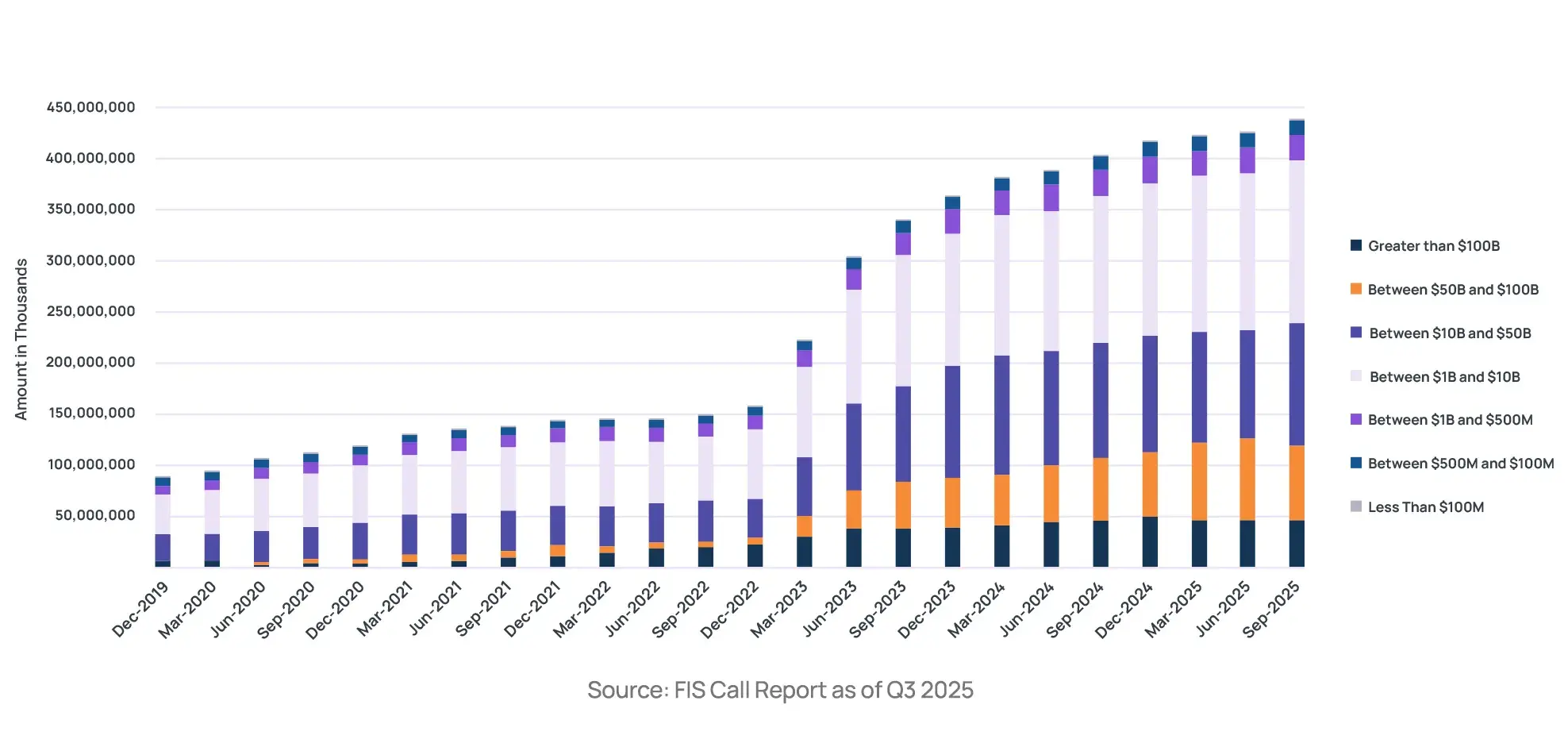
  • Smaller banks with less than $1 billion in assets have shown the fastest adoption, increasing to 1,271 participating institutions (up from approximately 1,063 in Dec 2022). They now hold $40.0 billion in reciprocal balances.

  • Banks with assets between $1 billion and $10 billion continue to hold the largest share of reciprocal balances, totaling $161.5 billion across 719 banks (up from roughly 564 banks holding $69.7 billion in Dec 2022).

  • Institutions with assets between $10 billion and $50 billion now account for $118.8 billion in reciprocal deposits across 84 banks, reflecting an increase in total balances despite a slight decrease in the number of participating institutions.

Stacked bar chart showing reciprocal deposit amounts in thousands from December 2019 to September 2025, segmented by bank asset size. The chart shows growth from approximately $80,000 thousand to $430,000 thousand, with the largest increases in banks with assets between $1B-$10B and greater than $100B. Source: FIS Call Report as of Q3 2025

Case Study: Expanding Deposit Base

Consider a mid-sized community bank aiming to expand its commercial lending book. The bank embraced reciprocal deposits because high-balance depositors often choose larger institutions for perceived safety. By offering depositors access to expanded FDIC deposit insurance coverage while keeping the relationship in-house, the bank attracted more substantial accounts and addressed deposit insurance concerns. It secured a more stable funding base to support its expanding lending activities.

Conclusion: A New Standard in Deposit Strategy

The steady rise in both volume and participation in reciprocal deposits signals more than a passing trend—it’s becoming the new standard in deposit strategy. For community banks, reciprocal deposits offer a powerful tool for effectively competing with larger banks, managing risk, and fostering growth.

Previous
Next

Media Contact

Melissa Kaiser
Director, Marketing

  • 1-212-830-5242
  • mkaiser@rnt.com

Don’t Miss Out on the Latest Insights.

Follow us on: image/svg+xml

Interested?

Learn how we can help you attract, grow & retain more deposits.

Contact Us

You are now leaving rnt.com

Stay on site

OR

Click to Continue
R&T Logo, White
aba partner network premiere
great place to work certified badge
  • 1-866-237-2752
  • info@rnt.com
  • 1370 Broadway, 17th Floor
    New York, NY 10018-7302
  • LinkedIn
  • Solutions
    • DDM®
    • CDMX℠
    • RTID®
    • Funding
  • Who We Serve
    • Depository Institutions
    • BaaS Banks
    • FinTechs
    • Trust Companies
    • Broker-Dealers
  • About R&T
    • Why R&T
    • Events
    • Testimonials
    • Leadership Team
    • Receiving Institution Lists
  • Technology
  • Resources
    • News & Insights
    • Collateral
    • Videos
    • Use Cases
    • Podcasts & Webinars

R&T Deposit Networks, LLC, R&T Deposit Marketplace, LLC, R&T Deposit Solutions, LLC and R&T Deposit Programs, LLC (each d/b/a R&T Deposit Solutions), each a Delaware limited liability company, (together, “R&T”) provide administrative, recordkeeping, and/or other services to banks, credit unions, trust companies, wealth management firms, broker-dealers and other institutions with respect to deposit placement and sweep programs, including the Demand Deposit Marketplace® (DDM®), Certificate of Deposit Marketplace Exchange℠ (CDMX℠) and R&T Insured Deposits℠ (RTID®) programs, as well as other services. An affiliate of R&T, Stable Custody Group II LLC (“Stable”), acts as agent of participating sending institutions under the DDM and CDMX programs.  R&T and Stable, together, “we”, “us” or “our”.  All of our services are provided subject to the terms and conditions of the written agreements and/or agency appointments between us and our clients with respect to those services, and we provide no representations or warranties, express or implied, except as expressly set forth in those written agreements and/or appointments. Click here for our legal and other disclosures. We are not an FDIC or NCUA-insured institution. FDIC insurance only covers the failure of an FDIC-insured institution. NCUA insurance only covers the failure of an NCUA-insured institution.  Certain conditions must be satisfied for FDIC and NCUA pass-through deposit insurance coverage to apply. Click here for a list of the FDIC and NCUA-insured institutions with which R&T has a direct or indirect business relationship for the placement of deposits under the DDM, CDMX, and RTID programs, and into which a participating institution may place deposits (subject to the terms of those programs and any opt-outs by the participating institution and/or its customers).  While the DDM, CDMX, and RTID programs provide access to an expanded level of FDIC or NCUA deposit insurance coverage on funds placed into the programs (subject to program terms and applicable laws, regulations and guidance, including pass-through insurance coverage requirements), the DDM, CDMX and RTID programs, themselves, as well as our other service offerings, are not insured or guaranteed by the FDIC or NCUA, are not deposits, and may lose value. We are not an affiliate of an FDIC or NCUA-insured institution, we are not an office, division, or sub-division of the FDIC or NCUA, and we are not associated with the FDIC or NCUA or office, division, or sub-division thereof. For more information about us, please visit our website at http://www.rt-deposit-solutions.local. The primary objective of the DDM, CDMX, and RTID programs is to provide customers with convenient access to expanded deposit insurance coverage on their funds (and not for investment enhancements, higher rates of returns or profits). R&T®, Reich & Tang®, Demand Deposit Marketplace®, DDM®, DepositView® and RTID® are registered marks of R&T Deposit Networks, LLC. CDMX℠, R&T Fusion℠ and Fusion by R&T℠ are pending marks of R&T Deposit Networks, LLC. IDEA℠ and Certificate of Deposit Marketplace Exchange℠ are unregistered service marks of R&T Deposit Networks, LLC.

© 2026 R&T Deposit Networks, LLC

  • Privacy Policy
  • Privacy Policy – CA
  • Terms of Use
  • Legal Disclosures
  • Receiving Institution Lists
  • DDM Program Limit
  • Do Not Share My Personal Information
  • Cookies