
Skip to content
How Financial Institutions Can Identify and Manage Third-Party Risk
R&T Logo, Blue
  • Solutions
    • DDM®
    • CDMX®
    • RTID®
    • Funding
  • Who We Serve
    • Depository Institutions
    • Trust Companies
    • BaaS Banks
    • FinTechs
    • Broker-Dealers
  • About R&T
    • Why R&T
    • Events
    • Testimonials
    • Leadership Team
    • Receiving Institution Lists
  • Technology
  • Resources
    • News & Insights
    • Collateral
    • Videos
    • Use Cases
    • Podcasts & Webinars
Contact Us
Contact Us
  • Solutions
    • DDM®
    • CDMX®
    • RTID®
    • Funding
  • Who We Serve
    • Depository Institutions
    • Trust Companies
    • BaaS Banks
    • FinTechs
    • Broker-Dealers
  • About R&T
    • Why R&T
    • Events
    • Testimonials
    • Leadership Team
    • Receiving Institution Lists
  • Technology
  • Resources
    • News & Insights
    • Collateral
    • Videos
    • Use Cases
    • Podcasts & Webinars
Contact Us
Back to News & Insights

How Financial Institutions Can Identify and Manage Third-Party Risk

October 20, 2026

From core banking platforms and payment processors to managed service providers, external partners are essential for the day-to-day operations of banks and other financial institutions.

But today’s third-party risk landscape extends well beyond direct vendor relationships.

As financial institutions become increasingly dependent on interconnected technology ecosystems, they inherit the risks embedded within those systems. Managing third-party risk requires an understanding of the dependencies that support every critical business service.

The Role of Third-Party Risk in Operational Resilience

Whereas third-party risk management (TPRM) was once viewed primarily as a back-office procurement or compliance function, it is now a prominent and critical component of operational resilience.

For banks, third-party risk spans multiple domains, including operational, cyber, regulatory, and reputational risk. Regulators increasingly expect financial institutions to understand not only who their critical service providers are, but how disruptions at those providers could impact customers and the broader financial system.

That shift requires banks to look beyond direct vendor relationships.

Assessing Vendor Dependency Chains

A bank may contract with a single technology provider, but that provider almost certainly relies on other organizations to deliver its services. Cloud infrastructure providers, software vendors, data centers, telecommunications providers, and managed service providers all form part of an extended dependency chain.

Those fourth- and fifth-party relationships often remain invisible to the financial institution, yet they can have a direct impact on service availability.

A disruption affecting one of these downstream providers can quickly ripple through the supply chain, resulting in outages, degraded services, or operational disruptions for the financial institution and its customers.

This is why leading TPRM programs are expanding beyond vendor inventories to gain greater visibility into the broader ecosystem supporting critical business services.

Concentration Risk Is Becoming More Complex

Concentration risk has long been a concern for banks, but it is taking new forms as technology stacks consolidate. While concentration risk is often discussed as a single concept, it typically appears in three distinct ways.

  • 1

    Single-Provider Dependency

    The most familiar form of concentration risk occurs when a bank relies heavily on one vendor to support critical business functions. Whether it’s a core banking platform, payment processor, or cybersecurity provider, the institution may have limited alternatives if that vendor experiences a cyberattack, operational outage, or financial distress.

    In many cases, switching providers quickly is neither practical nor feasible, making resilience planning essential.

  • 2

    Market Concentration

    Concentration risk also exists at the industry level. Today, many financial institutions rely on the same cloud providers, payment networks, cybersecurity platforms, and increasingly, AI technologies. As these markets orbit a relatively small number of dominant providers, a disruption affecting one organization has the potential to impact hundreds of banks simultaneously.

    This type of concentration elevates what might otherwise be an isolated vendor issue into a broader systemic concern, known as interconnectedness risk. Cyber contagion can be an example of this risk. The threat of cyber contagion is such that a single vulnerability/cyber event or operational failure spreads across multiple organizations through common dependencies.

  • 3

    Hidden Concentration

    Perhaps the most difficult concentration risk to identify is hidden concentration. A bank may believe it has diversified its vendor portfolio because it contracts with multiple providers. However, those providers may all depend on the same underlying cloud infrastructure, software components, data centers, or managed service providers. While the direct vendors appear independent, the underlying dependency is shared.

    Without visibility into these fourth- and fifth-party relationships, financial institutions may unknowingly create single points of failure within their technology ecosystems. Understanding these hidden dependencies is a critical component of effective third-party risk management and operational resilience.

Building a More Resilient Third-Party Risk Program

Managing third-party risk today requires a comprehensive view of the operational ecosystem that supports critical services.
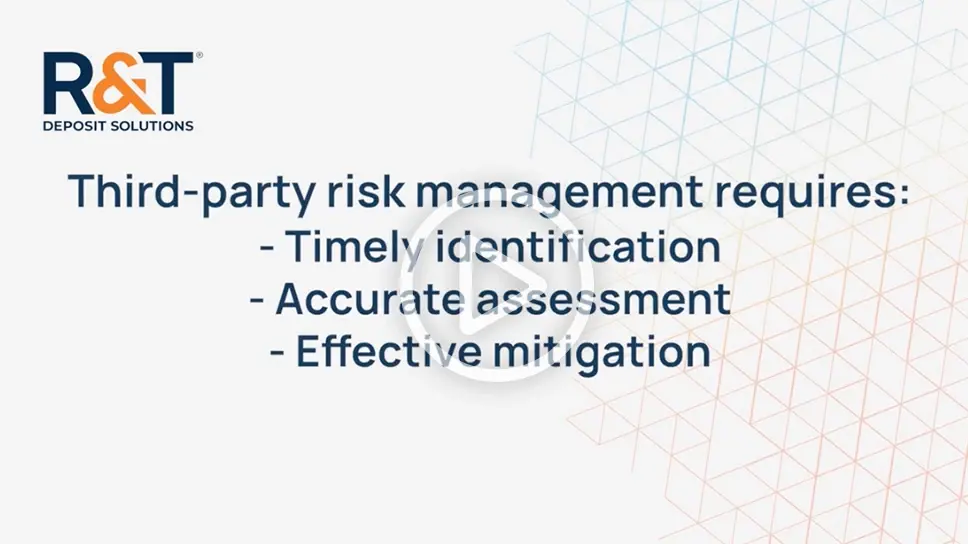
How Financial Institutions Can Identify and Manage Third-Party Risk

Watch Video

That means identifying not only critical vendors, but also the underlying providers they depend upon, continuously monitoring concentration risk, and evaluating how operational disruptions could cascade across multiple services.

Institutions that incorporate dependency mapping into their operational resilience programs will be better positioned to anticipate disruptions, respond more effectively to incidents, and meet evolving regulatory expectations.

As banks continue adopting cloud computing, AI, and outsourced technology services, the complexity of third-party systems will only increase.

The institutions that successfully navigate this landscape will be those that move beyond traditional vendor management and develop a deeper understanding of their entire dependency chain.

Previous

Media Contact

Melissa Kaiser
Director, Marketing

  • 1-212-830-5242
  • mkaiser@rnt.com

Don’t Miss Out on the Latest Insights.

Follow us on: image/svg+xml

Interested?

Learn how we can help you attract, grow & retain more deposits.

Contact Us

You are now leaving rnt.com

Stay on site

OR

Click to Continue
R&T Logo, White
aba partner network premiere
great place to work certified badge
  • 1-866-237-2752
  • info@rnt.com
  • 1370 Broadway, 17th Floor
    New York, NY 10018-7302
  • LinkedIn
  • Our Solutions
    • DDM®
    • CDMX®
    • RTID®
    • Funding
  • Who We Serve
    • Depository Institutions
    • Trust Companies
    • BaaS Banks
    • FinTechs
    • Broker-Dealers
  • About R&T
    • Why R&T
    • Events
    • Testimonials
    • Leadership Team
    • Receiving Institution Lists
  • Technology
  • Resources
    • News & Insights
    • Collateral
    • Videos
    • Use Cases
    • Podcasts & Webinars

R&T Deposit Networks, LLC, R&T Deposit Marketplace, LLC, R&T Deposit Solutions, LLC and R&T Deposit Programs, LLC (each d/b/a R&T Deposit Solutions), each a Delaware limited liability company, (together, “R&T”) provide administrative, recordkeeping, and/or other services to banks, credit unions, trust companies, wealth management firms, broker-dealers and other institutions with respect to deposit placement and sweep programs, including the Demand Deposit Marketplace® (DDM®), Certificate of Deposit Marketplace Exchange℠ (CDMX®) and R&T Insured Deposits℠ (RTID®) programs, as well as other services. An affiliate of R&T, Stable Custody Group II LLC (“Stable”), acts as agent of participating sending institutions under the DDM and CDMX programs.  R&T and Stable, together, “we”, “us” or “our”.  All of our services are provided subject to the terms and conditions of the written agreements and/or agency appointments between us and our clients with respect to those services, and we provide no representations or warranties, express or implied, except as expressly set forth in those written agreements and/or appointments. Click here for our legal and other disclosures. We are not an FDIC or NCUA-insured institution. FDIC insurance only covers the failure of an FDIC-insured institution. NCUA insurance only covers the failure of an NCUA-insured institution.  Certain conditions must be satisfied for FDIC and NCUA pass-through deposit insurance coverage to apply. Click here for a list of the FDIC and NCUA-insured institutions with which R&T has a direct or indirect business relationship for the placement of deposits under the DDM, CDMX, and RTID programs, and into which a participating institution may place deposits (subject to the terms of those programs and any opt-outs by the participating institution and/or its customers).  While the DDM, CDMX, and RTID programs provide access to an expanded level of FDIC or NCUA deposit insurance coverage on funds placed into the programs (subject to program terms and applicable laws, regulations and guidance, including pass-through insurance coverage requirements), the DDM, CDMX and RTID programs, themselves, as well as our other service offerings, are not insured or guaranteed by the FDIC or NCUA, are not deposits, and may lose value. We are not an affiliate of an FDIC or NCUA-insured institution, we are not an office, division, or sub-division of the FDIC or NCUA, and we are not associated with the FDIC or NCUA or office, division, or sub-division thereof. The primary objective of the DDM, CDMX, and RTID programs is to provide customers with convenient access to expanded deposit insurance coverage on their funds (and not for investment enhancements, higher rates of returns or profits). R&T®, Reich & Tang®, Demand Deposit Marketplace®, DDM®, DepositView®, CDMX®, and RTID® are registered marks and R&T DirectSM is a pending mark of R&T Deposit Networks, LLC. IDEA℠ , Certificate of Deposit Marketplace Exchange℠ , R&T Insured Deposits℠ and R&T Connect℠ are unregistered service marks of R&T Deposit Networks, LLC.

© 2026 R&T Deposit Networks, LLC

  • Privacy Policy
  • Privacy Policy – CA
  • Terms of Use
  • Legal Disclosures
  • Receiving Institution Lists
  • DDM Program Limit
  • Do Not Share My Personal Information
  • Cookies