




Bank customers with large deposits often face a trade-off. They can keep their cash at one bank and risk exceeding FDIC insurance limits or spread deposits across multiple banks and manage several banking relationships.
Reciprocal deposit networks offer another option. A financial institution can place its eligible customers’ funds through a network of participating banks, while preserving each customer’s primary banking relationship. This gives customers access to expanded deposit insurance coverage on their funds, and helps the bank retain valuable relationships, strengthen its funding strategy, and support lending in the communities it serves.
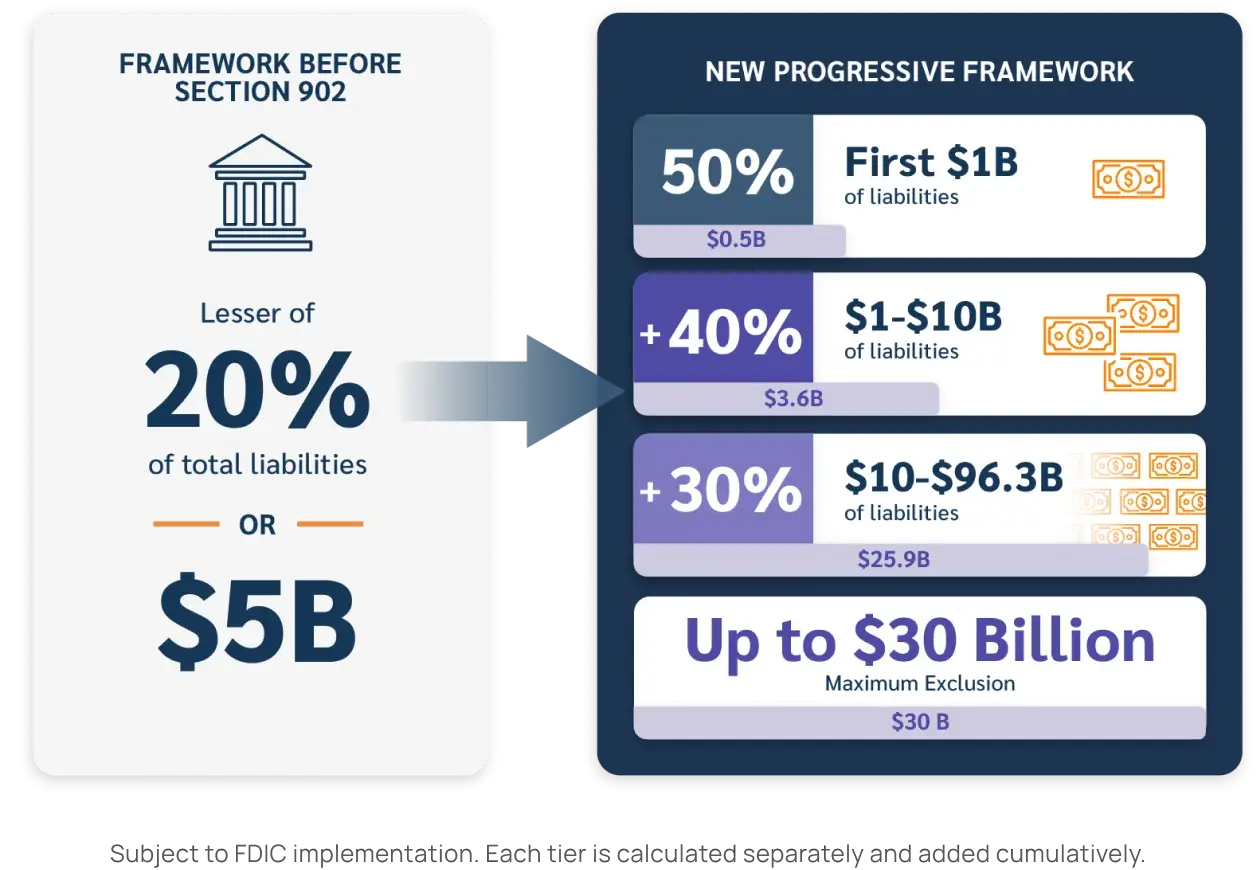
H.R. 6644, the 21st Century ROAD to Housing Act, became Public Law 119-101 on July 11, 2026, and significantly expands this opportunity. Section 902 replaces the former general cap—the lesser of $5 billion or 20% of total liabilities—with a tiered, liabilities-based framework that can provide up to $30 billion in non-brokered reciprocal deposit capacity. It also extends eligibility to well-capitalized institutions with CAMELS composite ratings of 1, 2, or 3. The FDIC’s conforming interim final rule became effective September 1, 2026. Institutions should confirm current Call Report instructions before implementation.
The change gives banks more room to use reciprocal deposits across commercial, public funds, trust, wealth, retail, private banking, escrow, and other specialty deposits. Reciprocal deposits increased from $156 billion in December 2022 to $481.1 billion in June 2026, and 2,117 banks, nearly half of all U.S. banks, now use them, according to FFIEC Call Report data.
Nearly Half of U.S. Banks Now Use Reciprocal Deposits
Banks using vs. not using reciprocal deposits, quarter-end, Q4 2019 to Q2 2026
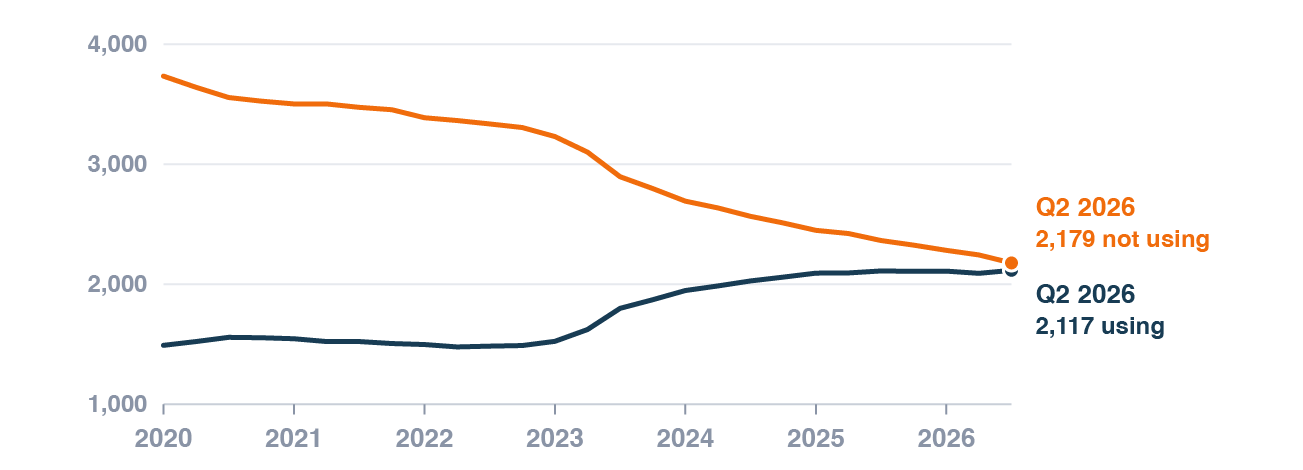
- 28.5% Share of banks using, Q4 2019
- 2,117 Banks using, Q2 2026
- 49.3% Share of banks using, Q2 2026
Source: FFIEC, Consolidated Reports of Condition and Income (Call Report), Schedule RC-E, Memorandum item 1.g (reciprocal deposits), quarter-end. A bank counts as using reciprocal deposits if it reported a balance greater than zero. R&T analysis.
For institutions that already use reciprocal deposits, this guide addresses two practical questions:
- How much additional capacity may be available?
- Where can that capacity create the greatest strategic value for your institution?
With the expanded capacity now available, banks should evaluate where reciprocal deposits can create the greatest value across their deposit strategies.
Part 1. The On-Ramp
Reciprocal Deposits, in Plain English
A business, municipality, nonprofit, family, or individual may want to keep more cash at one bank than standard FDIC insurance limits cover. Opening accounts at several banks takes time and fragments a relationship the bank has worked to build.
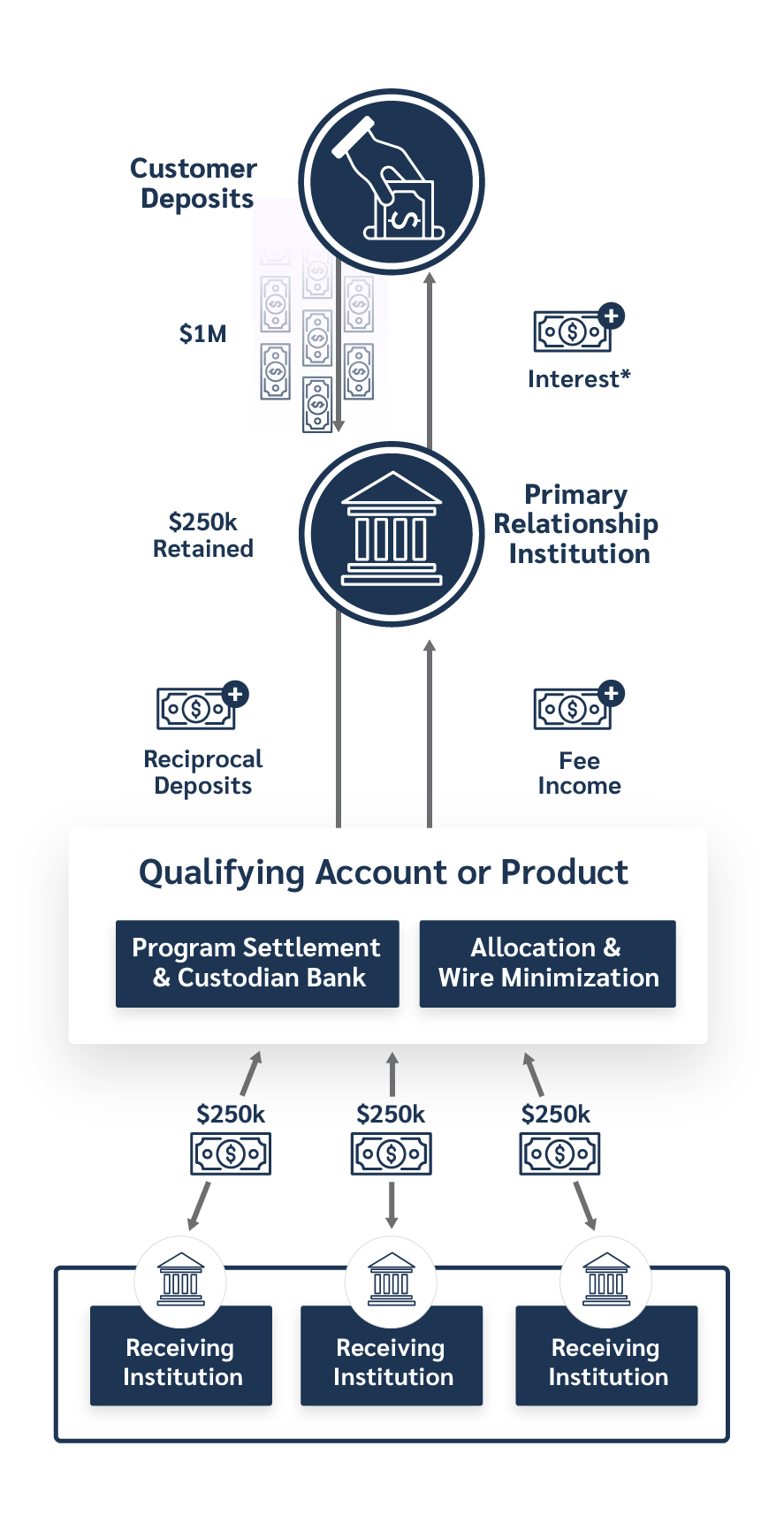
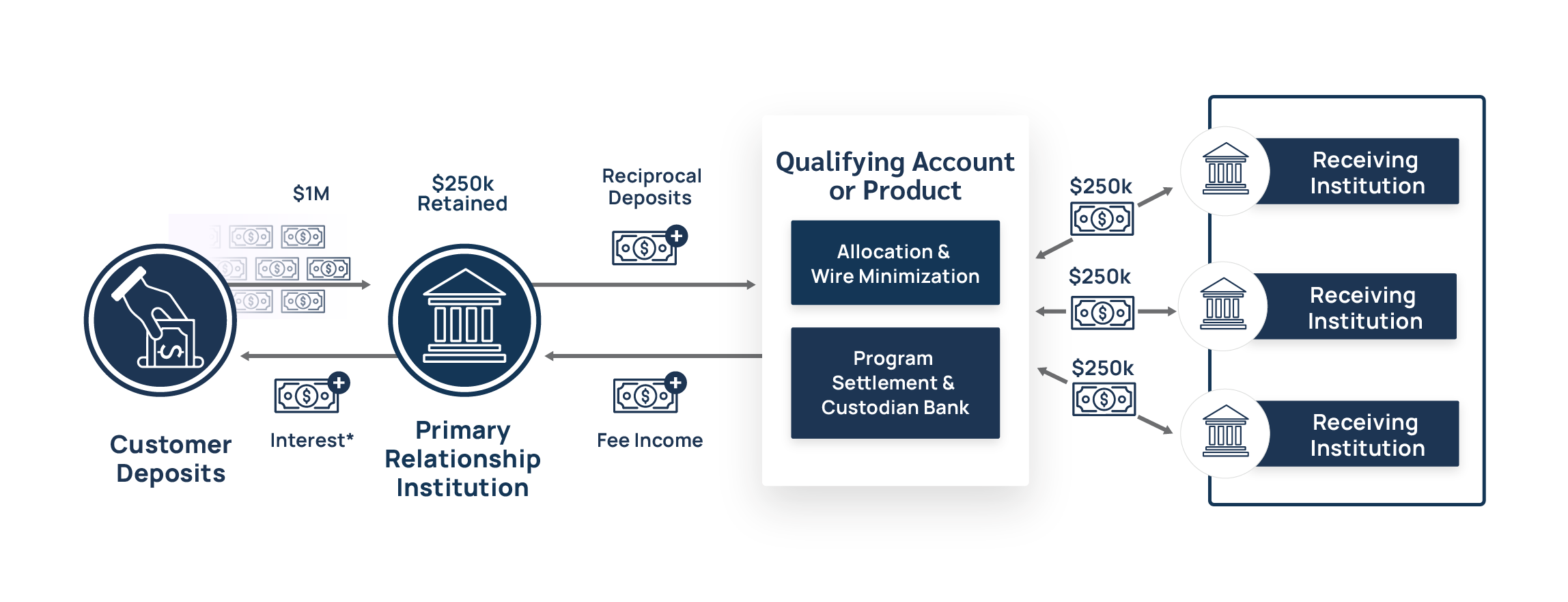
A reciprocal deposit program addresses this challenge. Under such a program, a bank places its customers’ funds into the program, with these funds allocated across numerous participating banks in amounts intended to remain within applicable deposit insurance limits. The customers receive access to an expanded level of deposit insurance coverage on their funds (up to the program limit), and continue to work with their primary bank.
Reciprocal programs are built around two-way deposit flows. Under the statutory definition, reciprocal deposits are matched in aggregate amount and, where applicable, maturity. Depending on the program structure and the institution’s funding needs, the bank may also be able to receive more or less than it places.
A reciprocal deposit program addresses this challenge. Under such a program, a bank places its customers’ funds into the program, with these funds allocated across numerous participating banks in amounts intended to remain within applicable deposit insurance limits. The customers receive access to an expanded level of deposit insurance coverage on their funds (up to the program limit), and continue to work with their primary bank.
Reciprocal programs are built around two-way deposit flows. Under the statutory definition, reciprocal deposits are matched in aggregate amount and, where applicable, maturity. Depending on the program structure and the institution’s funding needs, the bank may also be able to receive more or less than it places.
Why the structure matters
- One primary relationship. The customer does not manage a separate relationship with every receiving bank.
- Access to expanded deposit insurance coverage. Eligible balances spread across participating insured banks, up to the applicable limits and program capacity.
- Flexible deposit flows. Statutory reciprocal deposits are matched in aggregate, while some program options may allow the institution to receive more or less based on its funding needs.
- Operational visibility. A well-run program shows where funds sit and supports service, reconciliation, and oversight.
The potential applications are broad, including municipalities, businesses, nonprofits, fiduciary and escrow accounts, and families and individuals with large cash balances. These customers often need access to expanded deposit insurance coverage, convenience, and clear records of where their funds are held. The right structure depends on the product, rate, access to funds, account ownership category, and program terms.
How the Process Works
-
1
The customer begins with their bank. The bank places eligible funds in a qualifying account or product.
-
2
The bank places those funds into the program. The program prepares to allocate those funds across multiple participating receiving banks.
-
3
The program allocates the funds. Allocations reflect program rules, available capacity, applicable insurance limits, and account ownership categories.
-
4
The bank can receive funds from the network. Under a reciprocal structure, the bank receives a matching aggregate amount of funds from the program. Other available program options may allow it to receive more or less, depending on its funding needs and program terms.
-
5
The primary banking relationship stays in place. The customer continues to receive service through their own bank.
Part 2. Your New Capacity
What Section 902 Changed
H.R. 6644, the 21st Century ROAD to Housing Act, became Public Law 119-101 on July 11, 2026. Section 902, “Keeping Deposits Local,” replaces the former general cap, the lesser of $5 billion or 20% of total liabilities, with a progressive, liabilities-based framework.
Eligibility widened at the same time. Under the principal statutory route, well-capitalized institutions with a CAMELS composite rating of 1, 2, or 3 may qualify. A separate waiver route is also available, while a trailing four-quarter average applies in certain circumstances to institutions that no longer meet the principal eligibility requirements. An institution should confirm eligibility with legal, regulatory, and reporting advisers.
The law also directs the FDIC, in consultation with the Federal Reserve, to study how reciprocal deposits have performed since 2018. The FDIC must report its findings to Congress within six months of enactment.
The scale of the change makes it strategically significant. R&T estimates that potential industry-wide non-brokered reciprocal capacity could increase from approximately $1.3 trillion to $3.5 trillion under the new framework. This estimate is based on R&T’s analysis of FFIEC Call Report data and the tiered statutory formula. The additional capacity allows banks to consider a broader role for reciprocal deposits across funding, liquidity, and balancesheet strategies.
| Liability tier | Percentage | Maximum contribution to capacity |
|---|---|---|
| First $1 billion | 50% | $500 million |
| Above $1 billion through $10 billion | 40% | $3.6 billion |
| Above $10 billion through about $96.33 billion | 30% | $25.9 billion |
| Combined maximum, largest qualifying institutions | $30.0 billion |
Source: Public Law 119-101, Title IX, Section 902. Capacity is based on total liabilities and is subject to agentinstitution eligibility and other applicable requirements.
Your New Capacity
The impact becomes clearer when the new framework is applied to individual institutions. The table compares the former general cap with the new statutory capacity at four illustrative institution sizes.
The additional capacity can help institutions retain and attract funding. A $10 billion institution that was previously capped at $2.0 billion may now have approximately $4.1 billion in capacity, an increase of about $2.1 billion. A $50 billion institution may move from a $5.0 billion cap to approximately $16.1 billion, more than three times its former capacity.
The increase is particularly meaningful for institutions that were constrained by the former $5 billion cap. Their potential capacity may now be substantially higher, subject to eligibility and other applicable requirements.
Calculate your institution’s potential capacity.
The Reciprocal Deposit Reform Calculator applies the tiered formula to total liabilities.
Results are illustrative and subject to eligibility and other applicable requirements.
| Total liabilities | Former general cap | New statutory capacity |
|---|---|---|
| First $1 billion | $200 million | $500 million |
| $10 billion | $2.0 billion | $4.1 billion |
| $50 billion | $5.0 billion | $16.1 billion |
| $96.33 billion or more | $5.0 billion | $30.0 billion maximum |
Illustrative only. The former general cap reflects the lesser of $5 billion or 20% of total liabilities.
Part 3. Why, and Where
Why the New Capacity Matters to Strategy
Deposit protection is the starting point. Expanded capacity may also support four broader strategic goals.
Relationship growth and retention
A bank can address a large customer’s need for deposit protection while preserving the primary banking relationship. This can help retain existing balances, compete for deposits held elsewhere, and win new commercial, municipal, nonprofit, fiduciary, and high-net-worth relationships.
Funding flexibility and economics
Reciprocal deposits give Treasury teams a relationship-based alternative to wholesale funding, listing services, brokered CDs, collateralized public funds, and advances. A complete comparison should consider rates, fees, duration, collateral, operating costs, assessment effects, and liquidity value.
Liquidity and balance-sheet resilience
Reciprocal capacity can diversify funding, reduce uninsured-deposit concentrations, and give banks more flexibility to manage changing liquidity and balance-sheet needs.
Community impact
Retaining deposits can support lending in the markets a bank serves and help community-focused institutions compete for balances that might otherwise move to larger national providers.
Capturing this value requires the right program structure, pricing, and operating support. Banks should model the full economics for their own balance sheets before scaling because a change in deposit classification does not automatically improve every financial measure.
For depositors, the benefits are straightforward: access to expanded deposit insurance coverage on their funds (up to the relevant program limit), one primary banking relationship, and clear records showing where their funds are held.
Where to Apply It: Sources of Deposit Opportunity
Many banks begin with one use case, often public funds or commercial customers with large deposits that need protection. However, the ability to provide customers across the institution with access to expanded deposit insurance coverage on their funds makes it worthwhile to assess opportunities across the institution.
Bank leaders can use the following questions to evaluate each deposit source and determine whether a reciprocal structure fits the customer needs and the bank’s strategy.
- What is the customer solving for: protection, interest rate, liquidity, reporting, collateral, convenience, or several at once?
- How stable are the balances, and what triggers fast inflows or outflows?
- What ownership categories, fiduciary duties, or public-funds rules apply?
- What integration, reconciliation, and service requirements are unique to this source?
- Does the structure fit the bank’s liquidity, interest-rate-risk, and contingency-funding frameworks?
- How should bankers explain coverage and program limits without over promising?
| Source of funds | Common customer need | How it can help the bank |
|---|---|---|
| Commercial and corporate | Protection for operating cash and reserves | Retain deposits, deepen treasury relationships, add stable funding |
| Municipal and public funds | Insurance coverage and collateral efficiency | Compete for bids and reduce collateral needs, where permitted |
| Trust and fiduciary | Prudent cash management and clear records | Keep trust cash in-house and support fiduciary needs |
| Wealth and private banking | Safety, simplicity, and consolidated service | Strengthen high-value relationships and bring cash back |
| Retail and small business | Protection as balances grow | Retain customers and offer a distinctive service |
| Escrow, HOA, and specialty | Segregation, reporting, and predictable administration | Build specialized funding channels and strengthen retention |
Trust and Wealth Cash as a Source of Relationship Funding
Trust and wealth cash is often connected to customer relationships the bank already serves, even when the balances are held outside the bank.
Trust and wealth teams may allocate cash to money market funds or other external vehicles to meet fiduciary requirements, preserve liquidity, and provide competitive rates. With the right structure, some of these balances may also provide diverse, cost-effective funding for an affiliated bank.
A bank with a trust department or a bank-affiliated trust company can pursue this opportunity through the Demand Deposit Marketplace® (DDM®) program.
Under the DDM program, the bank or trust company places eligible customer cash into the program1, where it is allocated across a network of participating banks, all while maintaining the customer’s existing trust and banking relationship. Reciprocal options under the DDM program allow an eligible affiliated bank to receive deposits through the program’s network, turning trust cash management into a potential source of stable, cost-effective funding.
Customers receive competitive rates2 and access to expanded deposit insurance coverage on their funds, while the bank retains the customer relationship and a potential funding source.
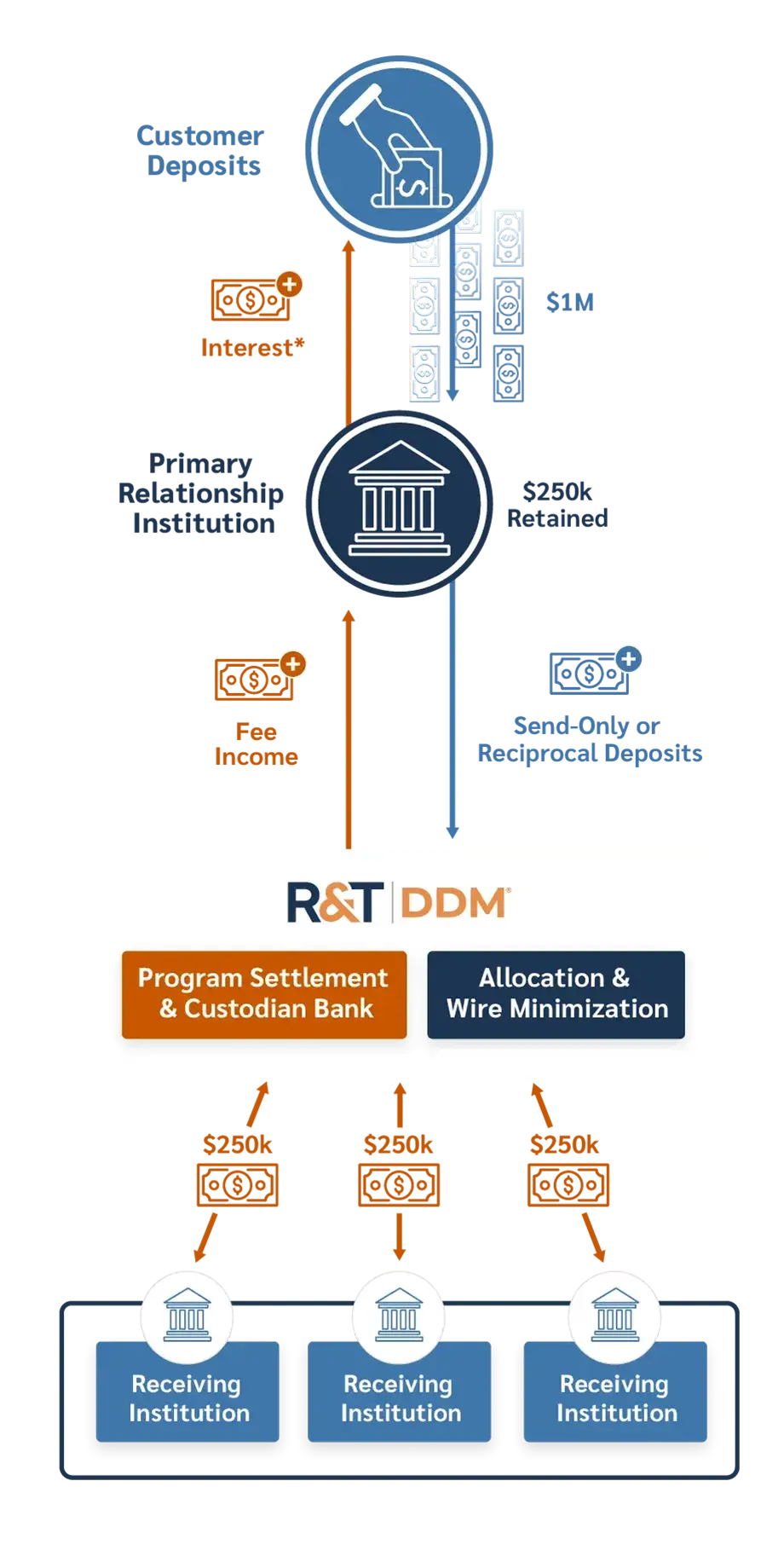
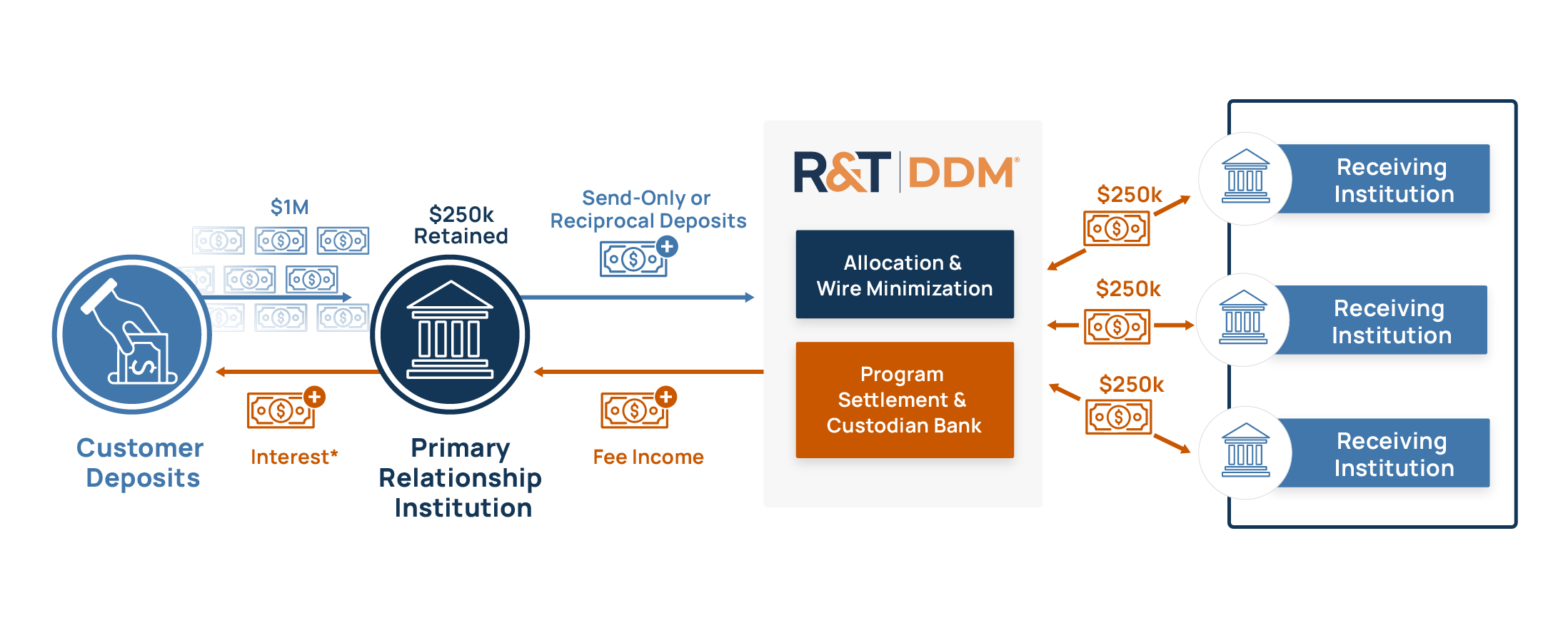
*Interest is paid by each receiving institution where the deposits are held, with the corresponding interest reflected in the customer’s account at their primary relationship institution.
“Receiving Institutions” are the insured depository institutions that can receive your customers’ funds under the DDM program. R&T offers the ability to place your customers’ funds at (i) receiving banks only or (ii) receiving banks and/or eligible credit unions. The DDM program allocates customers’ funds to as many receiving institutions as necessary to provide access to deposit insurance coverage from the FDIC or NCUA up to the program limit. Currently, under the DDM program, only credit unions that are designated as “low-income credit unions” (“LICUs”) can receive funds from sending institutions.
R&T pioneered deposit solutions for the trust market, with integrations across leading trust accounting platforms and program structures designed to support trust operations. These structures can help institutions address customer investment policy requirements and retain eligible balances within the bank, while trust companies remain responsible for meeting their own fiduciary and regulatory obligations3.
For institutions with trust or wealth management business lines, the expanded capacity created by Section 902 may present an immediate opportunity because the underlying customer relationships already exist. Trust teams are often best positioned to identify the opportunity, while Treasury and Finance evaluate the funding decision. Bringing these groups together is an important first step.
Part 4. Putting It to Work
Navigating the Transition

The statute and the FDIC’s implementing rule are now in effect, while reporting guidance may continue to evolve. The table below separates the three components of the implementation framework and the question each one answers.
In practice, the statute governs which qualifying reciprocal deposits may receive non-brokered treatment. The FDIC’s interim final rule, published and effective September 1, 2026, conforms the regulation to the new cap and eligibility provisions and clarifies how the reciprocal deposit framework operates. The FDIC may revise the rule after reviewing public comments. Call Report instructions govern how institutions report classifications, so banks should confirm the current instructions and coordinate with their legal, regulatory, accounting, and reporting advisers before expanding balances.
The economics also require careful analysis. A change from reported brokered to non-brokered status does not automatically reduce assessment expense, and balance growth can affect the assessment base, leverage ratio, and other pricing inputs. The net effect may be favorable, neutral, or offsetting, so institutions should model the full impact rather than assume one line item will improve.
| Layer | What it answers | Status |
|---|---|---|
| Federal statute | Which qualifying reciprocal deposits are treated as non-brokered | Amended by Public Law 119-101, Title IX, Section 902, effective July 11, 2026 |
| FDIC regulation, 12 CFR 337.6 | How the FDIC administers the exception | Conforming interim final rule approved August 27, 2026, published and effective September 1, 2026, with a 30-day comment period (comments due October 1, 2026) |
| FFIEC Call Report instructions | How classifications are reported each quarter | Reconfirm current instructions before implementation |
Institutions should confirm the current status of each component before implementation.
Banks should balance speed with readiness. Moving too slowly may delay opportunities to use the expanded capacity, while moving too quickly may create reporting or process issues.
The right pace depends on funding needs, ratings and capital, reporting readiness, internal controls, and the supervisory relationship.
Seven-step playbook for bank leaders:
-
Quantify Capacity
Calculate capacity under the new formula, compare it with current reciprocal balances, and note internal policy limits.
-
Map Opportunities
Assess commercial, public funds, trust, wealth, retail, escrow, and specialty deposits.
-
Prioritize Use Cases
Rank opportunities by deposit potential, relationship value, operating complexity, time to market, and strategic fit.
-
Model the Economics
Compare rates, fees, collateral, operating costs, capital, assessments, liquidity value, and stress-case behavior.
-
Establish Governance
Align Treasury, Finance, Compliance, Legal, Operations, and business leadership on classification, reporting, limits, and documentation.
-
Design and Enable
Select program structures, integrations, controls, and customer communications, then train relationship teams.
-
Stage the Rollout
Expand in line with funding needs, measure results, and refine before broadening.
What Comes Next
Reciprocal deposits offer two practical benefits. Customers gain access to expanded deposit insurance coverage on their funds, while their primary bank can receive deposits back from the program’s network. H.R. 6644 substantially increases the non-brokered reciprocal capacity available to qualifying institutions.
Banks can use this opportunity to connect deposit strategy across business lines and create a repeatable approach to funding the customer relationships they already serve.
How R&T Can Help
R&T Deposit Solutions provides configurable programs for bank funding and trust and wealth deposit management, with support for escrow and other specialty deposits. Our private-label capabilities allow institutions to offer deposit solutions under their own brand while remaining the customer’s primary point of contact. R&T also supports strategy, technology integrations, relationship management, marketing, and banker education.
Ready to assess the opportunity for your institution?
Start with R&T’s Reciprocal Deposit Reform Calculator, then contact R&T Deposit Solutions to discuss your deposit strategy
Glossary
Agent institution. An insured depository institution that meets the statutory conditions for reciprocal deposits to receive non-brokered treatment.
Covered deposit. A deposit submitted by an agent institution for placement through a deposit placement network that was not obtained through a deposit broker.
Deposit placement network. A network of insured depository institutions that processes the placement and receipt of reciprocal deposits.
Reciprocal deposit. A deposit received through a placement network in the same aggregate amount, and with the same maturity if any, as covered deposits placed at other network banks.
Pass-through deposit insurance. Coverage that may apply to the interests of underlying beneficial owners when the applicable statutory, regulatory, and record keeping requirements are satisfied.
Sources and Regulatory Context
1. What Are Reciprocal Deposits?, R&T Deposit Solutions.
2. Public Law 119-101, Title IX, Section 902, 21st Century ROAD to Housing Act, enacted July 11, 2026.
3. Reciprocal Deposits: Implementing the 21st Century ROAD to Housing Act, FDIC interim final rule amending 12 CFR 337.6, published and effective September 1, 2026 (FDIC Board approved August 27, 2026; comments due October 1, 2026).
4. FFIEC Reporting Forms, Call Report materials.
5. Reciprocal deposit growth ($156 billion to $481.1 billion, December 2022 to June 30, 2026) and participating banks (2,117): R&T analysis of FFIEC Call Report data for Q2 2026.
Important Disclosures
1 In general, a bank with a trust department can enter the DDM program through the direct-source model of the program, with the bank acting as the Sending Institution. A bank-affiliated trust company, in general, can enter the DDM program through the direct-source model of the program (if the trust company is federally chartered) or the indirect-source model of the program (if the trust company is state chartered).
2 Interest rates on funds placed through the program may, under certain circumstances, outperform cash alternatives such as money market funds, but the primary objective of the DDM program is to provide access to expanded deposit insurance coverage, not investment enhancement or higher returns.
3 Subject to applicable laws, regulations, rules, and limits relating to brokered deposits, including Section 29 of the Federal Deposit Insurance Act (12 U.S.C. 1831f), as amended, its implementing regulations, including 12 CFR 337.6, and applicable Call Report instructions from the FFIEC. R&T makes no representations or warranties, express or implied, with respect to an institution’s classification of deposits as brokered or not brokered. Such determination is entirely and solely the responsibility of that institution.
This e-book is for informational purposes only, reflects publicly available information as of the date shown, and is not legal, accounting, investment, or regulatory advice. Institutions should consult their advisers and regulators regarding their specific circumstances.