
Skip to content
Addressing Banking Stress After the Latest Bank Failure of 2026
R&T Logo, Blue
  • Solutions
    • DDM®
    • CDMX℠
    • RTID®
    • Funding
  • Who We Serve
    • Depository Institutions
    • BaaS Banks
    • FinTechs
    • Trust Companies
    • Broker-Dealers
  • About R&T
    • Why R&T
    • Events
    • Testimonials
    • Leadership Team
    • Receiving Institution Lists
  • Technology
  • Resources
    • News & Insights
    • Collateral
    • Videos
    • Use Cases
    • Podcasts & Webinars
Contact Us
Contact Us
  • Solutions
    • DDM®
    • CDMX℠
    • RTID®
    • Funding
  • Who We Serve
    • Depository Institutions
    • BaaS Banks
    • FinTechs
    • Trust Companies
    • Broker-Dealers
  • About R&T
    • Why R&T
    • Events
    • Testimonials
    • Leadership Team
    • Receiving Institution Lists
  • Technology
  • Resources
    • News & Insights
    • Collateral
    • Videos
    • Use Cases
    • Podcasts & Webinars
Contact Us
Back to News & Insights

Addressing Banking Stress After the Latest Bank Failure of 2026

June 4, 2026

On May 1, 2026, the US experienced its 11th bank failure since 2023, as Georgia regulators closed Community Bank and Trust – West Georgia in LaGrange, Georgia. According to the ABA Banking Journal, approximately $27 million in deposits at the bank are believed to have exceeded FDIC insurance limits, while the FDIC estimated that the failure would cost its Deposit Insurance Fund approximately $97 million.

The incident comes months after the Illinois Department of Financial and Professional Regulation closed Metropolitan Capital Bank & Trust, Chicago. The FDIC estimated that failure would cost its Deposit Insurance Fund $19.7 million.

The events are the latest in a series of failures that have continued since March 2023, when Silicon Valley Bank collapsed, triggering the most significant banking stress since 2008. That crisis exposed a different vulnerability: concentrated uninsured deposits that fled at digital speed. SVB, Signature Bank, and First Republic collectively held over $500 billion in assets. Their failures prompted emergency intervention, systemic risk exceptions, and hard questions about the adequacy of deposit insurance.

Why Traditional Models Remain Vulnerable

According to FDIC data, uninsured deposits across the U.S. banking system remain substantial, particularly for mid-sized and regional institutions. When depositors believe their funds are at risk, particularly for deposits that exceed FDIC deposit limits, they move quickly. Modern banking infrastructure enables deposit flight at unprecedented speed.
"The uninsured deposit run that led to the failure of Silicon Valley Bank in March 2023 underscored that a core deposit program can have severe and fatal risk characteristics that executive teams must 
also manage."

Rate competition, while effective at attracting deposits during stable periods, does not address the underlying safety concern that drives deposit flight during stress. Bank Director observed after the Silicon Valley Bank failure: “The uninsured deposit run that led to the failure of Silicon Valley Bank in March 2023 underscored that a core deposit program can have severe and fatal risk characteristics that executive teams must also manage.”

The structural issue is straightforward. Banks with concentrated uninsured deposits face liquidity risk when depositor confidence shifts. Traditional assumptions about deposit stickiness, built during decades of slower withdrawal mechanisms and less publicly available information about bank health, no longer hold in an environment where depositors can monitor capital ratios in real time and execute transfers from mobile devices.

In fact, in a recent survey of Banking-as-a-Service and FinTech executives conducted by R&T Deposit Solutions, 74% of BaaS and 78% of FinTech respondents say expanded FDIC coverage is highly important. The report, “Safety, Scale, and the Trust Dividend,” showed that nearly all respondents cite past bank failures as an impetus for wanting to improve deposit protection.

The Case for Structural Diversification

Banks that treat concentration risk as a structural problem rather than a periodic liquidity-management issue have adjusted their funding strategies accordingly. Diversification across funding sources and institutions improves stability when depositor behavior becomes more risk-sensitive.

Deposit network programs enable banks to exchange deposits with peer institutions, allowing customers to access expanded FDIC insurance coverage while maintaining a single banking relationship. Each receiving bank in the network provides standard FDIC insurance coverage on its portion of the deposit, effectively distributing the customer’s balance across multiple institutions without requiring the customer to open multiple accounts or track multiple relationships.

From the bank’s perspective, the network provides diversified funding that does not rely on a concentrated set of large depositors. From the depositor’s perspective, the arrangement provides access to expanded deposit insurance beyond the standard FDIC limit without operational complexity.

Structural diversification should be a baseline funding strategy for institutions operating in an environment where depositor behavior has permanently changed. No single funding source eliminates concentration risk. The objective is a diversified funding profile that remains stable across different stress scenarios.

Cost vs. Crisis: The Real Funding Comparison

Banks should evaluate diversification mechanisms, including but not limited to deposit networks, brokered deposit programs managed for stability rather than cost, and wholesale funding arrangements with predictable renewal terms. The specific mechanism matters less than the outcome: a funding profile that can withstand depositor behavior during stress without requiring emergency capital raises or asset liquidation.

While diversified funding may initially seem more expensive than concentrated uninsured deposits during stable periods, cost comparisons that ignore stress scenarios are incomplete. The relevant comparison is the cost of diversified funding versus the cost of managing a liquidity crisis when concentrated funding disappears.

The institutions that emerge from the next bank stress intact will be those that modernize their deposit structure before the headline, not after.
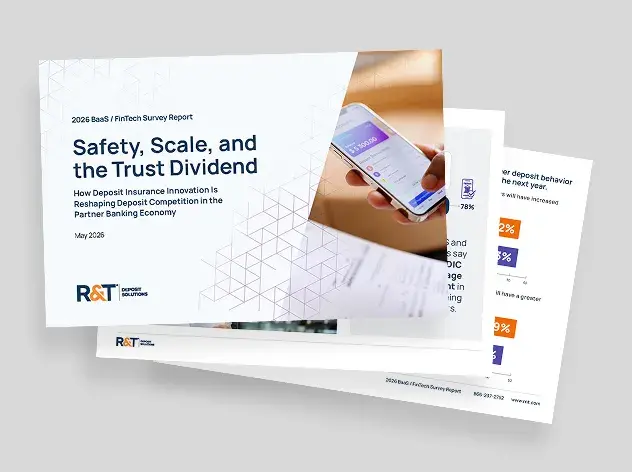
How Deposit Insurance Innovation Is Reshaping Deposit Competition in the Partner Banking Economy

Download the 2026 BaaS / FinTech Survey Report
Previous

Media Contact

Melissa Kaiser
Director, Marketing

  • 1-212-830-5242
  • mkaiser@rnt.com

Don’t Miss Out on the Latest Insights.

Follow us on: image/svg+xml

Interested?

Learn how we can help you attract, grow & retain more deposits.

Contact Us

You are now leaving rnt.com

Stay on site

OR

Click to Continue
R&T Logo, White
aba partner network premiere
great place to work certified badge
  • 1-866-237-2752
  • info@rnt.com
  • 1370 Broadway, 17th Floor
    New York, NY 10018-7302
  • LinkedIn
  • Solutions
    • DDM®
    • CDMX℠
    • RTID®
    • Funding
  • Who We Serve
    • Depository Institutions
    • BaaS Banks
    • FinTechs
    • Trust Companies
    • Broker-Dealers
  • About R&T
    • Why R&T
    • Events
    • Testimonials
    • Leadership Team
    • Receiving Institution Lists
  • Technology
  • Resources
    • News & Insights
    • Collateral
    • Videos
    • Use Cases
    • Podcasts & Webinars

R&T Deposit Networks, LLC, R&T Deposit Marketplace, LLC, R&T Deposit Solutions, LLC and R&T Deposit Programs, LLC (each d/b/a R&T Deposit Solutions), each a Delaware limited liability company, (together, “R&T”) provide administrative, recordkeeping, and/or other services to banks, credit unions, trust companies, wealth management firms, broker-dealers and other institutions with respect to deposit placement and sweep programs, including the Demand Deposit Marketplace® (DDM®), Certificate of Deposit Marketplace Exchange℠ (CDMX℠) and R&T Insured Deposits℠ (RTID®) programs, as well as other services. An affiliate of R&T, Stable Custody Group II LLC (“Stable”), acts as agent of participating sending institutions under the DDM and CDMX programs.  R&T and Stable, together, “we”, “us” or “our”.  All of our services are provided subject to the terms and conditions of the written agreements and/or agency appointments between us and our clients with respect to those services, and we provide no representations or warranties, express or implied, except as expressly set forth in those written agreements and/or appointments. Click here for our legal and other disclosures. We are not an FDIC or NCUA-insured institution. FDIC insurance only covers the failure of an FDIC-insured institution. NCUA insurance only covers the failure of an NCUA-insured institution.  Certain conditions must be satisfied for FDIC and NCUA pass-through deposit insurance coverage to apply. Click here for a list of the FDIC and NCUA-insured institutions with which R&T has a direct or indirect business relationship for the placement of deposits under the DDM, CDMX, and RTID programs, and into which a participating institution may place deposits (subject to the terms of those programs and any opt-outs by the participating institution and/or its customers).  While the DDM, CDMX, and RTID programs provide access to an expanded level of FDIC or NCUA deposit insurance coverage on funds placed into the programs (subject to program terms and applicable laws, regulations and guidance, including pass-through insurance coverage requirements), the DDM, CDMX and RTID programs, themselves, as well as our other service offerings, are not insured or guaranteed by the FDIC or NCUA, are not deposits, and may lose value. We are not an affiliate of an FDIC or NCUA-insured institution, we are not an office, division, or sub-division of the FDIC or NCUA, and we are not associated with the FDIC or NCUA or office, division, or sub-division thereof. For more information about us, please visit our website at https://www.rnt.com. The primary objective of the DDM, CDMX, and RTID programs is to provide customers with convenient access to expanded deposit insurance coverage on their funds (and not for investment enhancements, higher rates of returns or profits). R&T®, Reich & Tang®, Demand Deposit Marketplace®, DDM®, DepositView® and RTID® are registered marks of R&T Deposit Networks, LLC. CDMX℠ is a  pending mark of R&T Deposit Networks, LLC. IDEA℠ and Certificate of Deposit Marketplace Exchange℠ and R&T Insured Deposits℠ are unregistered service marks of R&T Deposit Networks, LLC.

© 2026 R&T Deposit Networks, LLC

  • Privacy Policy
  • Privacy Policy – CA
  • Terms of Use
  • Legal Disclosures
  • Receiving Institution Lists
  • DDM Program Limit
  • Do Not Share My Personal Information
  • Cookies