A configurable deposit program with send, receive, and reciprocal options.
The DDM® program enables financial institutions of all sizes to offer access to millions of dollars in expanded FDIC deposit insurance coverage at competitive rates1 and at scale. Institutions can dynamically adjust how deposits are sent, received, or reciprocated, allowing them to attract large depositors, manage deposit mix, and support multiple balance sheet objectives through a single program.
How the DDM Program Delivers Value
The DDM program helps institutions attract deposits, reduce risk, and maintain control over pricing, liquidity, and balance sheet strategy.
Attract and Retain Customers
Offer customers access to millions in FDIC deposit insurance coverage, daily liquidity2, and competitive rates1, and give high-net-worth individuals, corporate depositors, and public funds a compelling reason to consolidate balances with your institution.
Reduce Risk and Volatility
Manage your uninsured deposit exposure and reduce your uninsured balances to lower the risk of deposit flight under stress and give regulators and analysts a more stable picture of your funding base.
Configure and Control
Choose your program structure, set your own pricing, and adjust as your balance sheet evolves.
Generate Fee Income
Earn fee income on deposits placed into the DDM program.
DDM Advantages
The DDM program combines flexible, program-level control with a broad bank network and real-time reporting to support scalable, transparent deposit programs.
Configurable by Design
The DDM program adapts to your institution, your customers, and your evolving program needs.
Institution-level management enhances flexibility and balance sheet control
R&T experts can help customize program design, strategy, and pricing
Private labeling delivers a branded experience for customers
The Reliable and Trusted Network
Place large balances efficiently and serve customers with the capabilities of a large institution.
Provides access to millions in FDIC deposit insurance coverage
Includes 350+ participating banks
Serves 11M+ customer accounts
Modern Platform, Powerful Integrations
DDM supports scalable deposit programs with flexible integrations, reporting tools, and self-service access.
Integrates with 50+ core processors and trust accounting platforms
APIs, portals, and reporting tools enhance operational visibility and program management
Flexible onboarding and infrastructure for evolving program needs
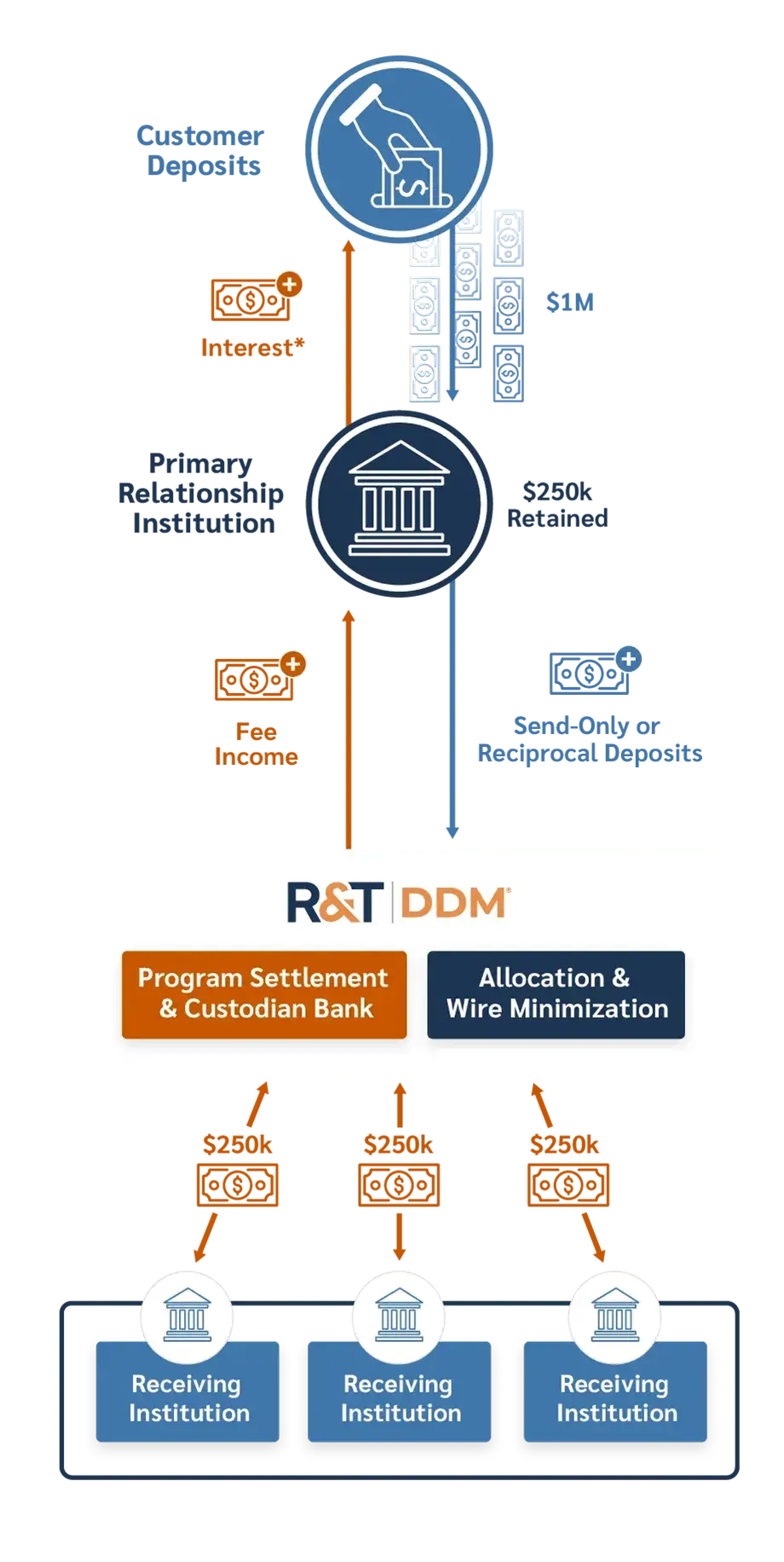
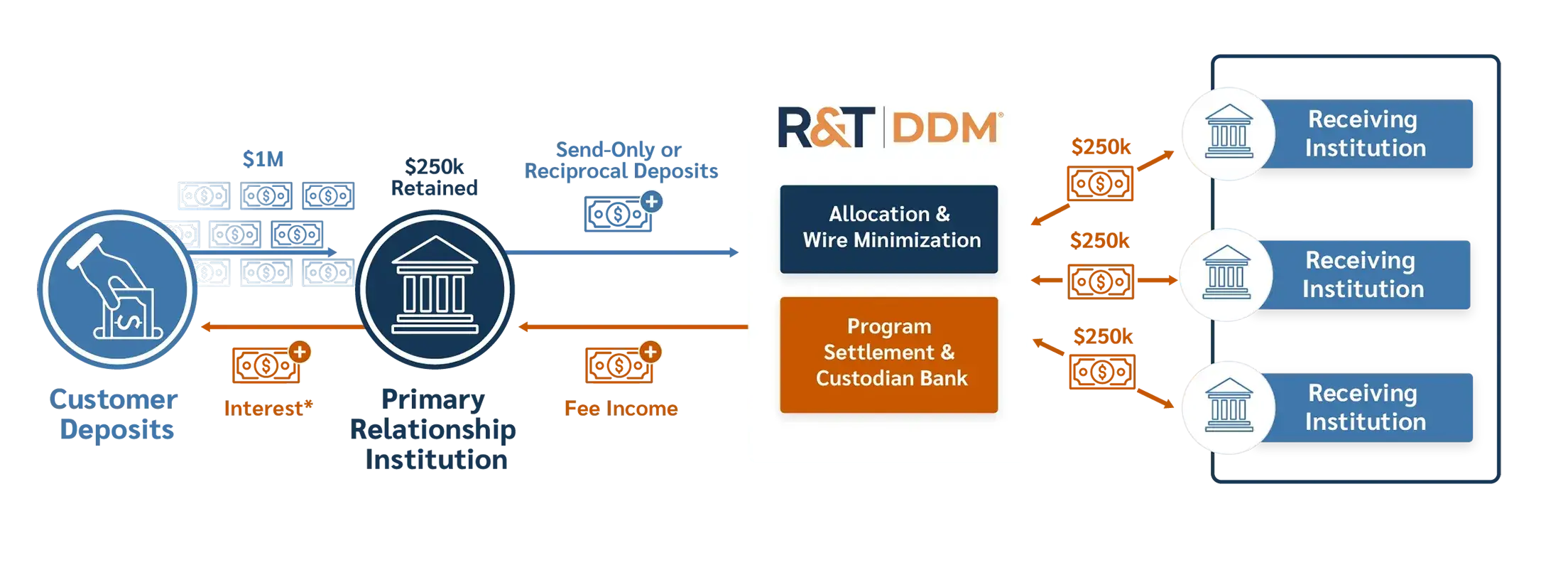
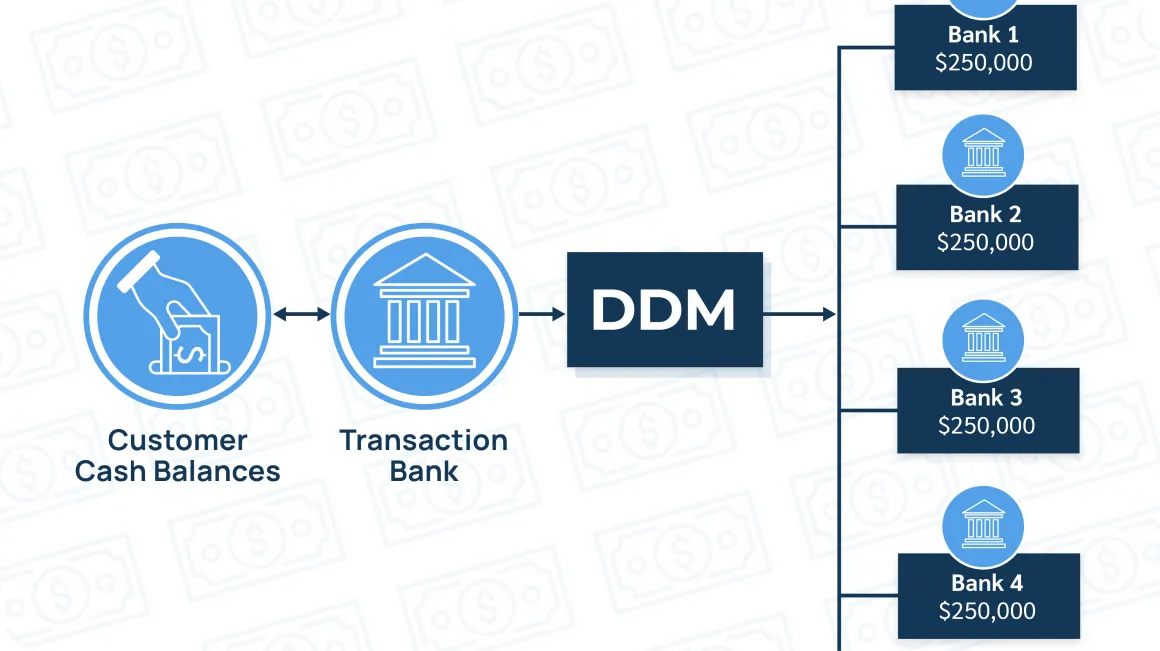
Cash balances from your customers’ accounts are swept into the DDM program on a send-only or reciprocal basis and allocated into deposit accounts at participating receiving institutions in increments of up to $250K per eligible depositor (based on customer identifier)3, per receiving institution. This allows your customers to access expanded deposit insurance on their funds, up to the relevant program limit4, while maintaining daily access to their funds through their relationship with your institution.
*Interest is paid by each receiving institution where the deposits are held, with the corresponding interest reflected in the customer’s account at their primary relationship institution.
“Receiving Institutions” are the insured depository institutions that can receive your customers’ funds under the DDM program. R&T offers the ability to place your customers’ funds at (i) receiving banks only or (ii) receiving banks and/or eligible credit unions. The DDM program allocates customers’ funds to as many receiving institutions as necessary to provide access to deposit insurance coverage from the FDIC or NCUA up to the program limit. Currently, under the DDM program, only credit unions that are designated as “low-income credit unions” (“LICUs”) can receive funds from sending institutions.
DDM Program Options
Send-Only
Send excess deposit balances
Provide access to expanded deposit insurance coverage
Generate fee income
On-demand funding for balance sheet deposits
Receive-Only (Funding Solutions)
Receive deposit funding
Diversify wholesale funding sources
Fund loan demand
Strengthen balance sheet and supplement contingency funding plans
Reciprocal
Exchange deposits on a dollar-for-dollar basis
Provide access to expanded deposit insurance coverage
Send uninsured balances and receive deposits in return
Eligible for non-brokered treatment up to legal limits for qualifying institutions5
Reciprocal Plus/Minus
Exchange deposits in any desired ratio
Provide access to expanded deposit insurance coverage
Dynamically increase or decrease deposit levels
Set reciprocal targets to send or receive balances above or below a target
FinTechs access the infrastructure and capacity to support scalable deposit programs by working with sponsor banks that participate in the DDM program.
Trust companies choose the DDM program because it can help them align with customers’ investment policies and goals and potentially deliver competitive returns.1
The DDM sweep program is tailored for regulated broker-dealers to allow them to deliver an insured cash sweep solution with control over deposits, bank selection, and program structure.
The DDM program is designed to address a wide range of deposit and balance sheet challenges, including:
Elevated Uninsured Deposit Risk
A high concentration of uninsured balances increases funding volatility and draws regulatory attention to your deposit mix.
Opportunity Cost of Collateral
Pledging high-quality assets against public fund deposits consumes balance
sheet capacity that could be generating a return elsewhere.
Untapped Value Across Business Lines
Trust department cash sitting in money market funds is an internal funding source most banks haven't captured.
Meeting Regulatory Requirements for Public Funds
Public funds and other specialty deposits entail complex regulatory, collateral, and reporting requirements that many deposit programs aren’t designed to support.
Managing Deposit Volatility
Changing market conditions, depositor behavior, and competitive pressures can create fluctuations in deposit levels, funding needs, and liquidity requirements.
Growth Outpacing Balance Sheet Capacity
Sponsor banks supporting fast-growing FinTech programs can see deposit growth exceed what their balance sheet is designed to absorb.
Large-balance deposits that exceed FDIC insurance limits increase uninsured exposure and create funding volatility. Certain public, corporate, and regulated balances may also require collateralization or other protections to address counterparty exposure and risk, increasing costs and limiting flexibility. A high uninsured deposit ratio is both a regulatory trigger and an analyst signal. When confidence in a bank wavers, uninsured depositors have every incentive to move first.
Solution
Financial institutions use the Demand Deposit Marketplace (DDM) program to distribute large balances across a network of participating institutions, providing access to millions of dollars in FDIC deposit insurance while maintaining the customer relationship.
Banks can actively manage the mix of insured and uninsured deposits, optimize funding costs, and determine how much to retain, place within the network, or receive based on their balance sheet needs.
Benefits
Reduce uninsured deposit ratios and funding volatility
Reduce collateral requirements tied to uninsured deposits
Retain large deposit relationships without overpaying for funds
Gain greater control funding costs and balance sheet composition
Opportunity Cost of Collateral
Free Up Collateral. Unlock Balance Sheet Capacity.
Challenge
Pledging collateral to secure deposits limits flexibility to deploy those assets into lending or other income-generating activities and constrains an institution’s ability to compete for large-balance relationships.
Solution
Financial institutions use the DDM program to place deposits across a network of participating institutions, providing access to FDIC insurance coverage and reducing or eliminating the need for collateral.
This approach replaces costly collateral and surety bond arrangements with a more efficient alternative, while giving institutions greater control over deposit levels, funding costs, and the retention, placement, or reciprocation of funds within the network.
Benefits
Free up high-quality assets for lending or higher-yielding investments
Reduce collateral requirements and associated costs
Compete for larger deposits without paying above-market rates1
Gain greater control over funding costs and insured-to-uninsured deposit mix
Strengthen liquidity profile with additional capacity to support funding needs
Untapped Value Across Business Lines
Turn Internal Cash Into a Funding Source.
Challenge
Trust and wealth-related cash is often placed in money market funds or external vehicles rather than being held within the bank.
Lack of coordination across business lines, combined with fiduciary and regulatory requirements, can prevent institutions from using these balances as a stable, cost-effective funding source.
Solution
Financial institutions use the Demand Deposit Marketplace (DDM) program to help align trust and banking operations, placing customer cash into insured deposits across a network of participating institutions.
R&T pioneered deposit solutions for the trust market and is the leading provider for both independent and bank-affiliated trust company sweep programs. With integrations across trust accounting platforms and structures designed to help trust companies support investment policy requirements, institutions can retain and deploy these balances internally while still supporting their fiduciary and regulatory expectations6.
Benefits
Capture a new, cost-effective source of funding from existing relationships
Keep deposits within the broader organization, rather than losing them to external products
Support fiduciary and regulatory requirements with appropriate structures6
Strengthen coordination across business lines to improve the overall funding strategy
Deliver competitive, insured options to trust and wealth customers
Public funds, specialty deposits, and other fiduciary accounts carry unique legal, regulatory, collateral, and reporting requirements.
These requirements often limit how funds can be placed, allocated, and reported, making many deposit programs unsuitable and forcing institutions to rely on less efficient, less flexible, or more costly alternatives.
Solution
Financial institutions use the DDM program to place escrow and specialty deposits within a network of participating institutions, using structures designed to help support specific regulatory, reporting, collateral, and allocation requirements.
R&T has a proven track record of helping institutions navigate complex approval processes, implement tailored allocation strategies, and integrate with required reporting frameworks, opening up deposit sources that many programs cannot support.
Benefits
Capture deposit opportunities from public funds and specialty accounts
Meet complex regulatory, reporting, and allocation requirements6
Reduce reliance on collateral or surety-based alternatives
Improve scalability with tailored structures and reporting
Extend deposit capabilities to support specialized customer segments
Managing Deposit Volatility
Adapt to Change. Maintain Balance Sheet Control.
Challenge
Changing market conditions, depositor behavior, and competitive pressures can create fluctuations in deposit levels, funding needs, and liquidity requirements.
Periods of rapid deposit inflows or outflows can make it difficult to maintain target balance sheet composition and manage funding costs.
Solution
The Demand Deposit Marketplace (DDM) program gives financial institutions the flexibility to send, receive, and reciprocate deposits as funding needs change.
DDM users can dynamically manage deposit levels across a network of hundreds of participating institutions to maintain greater control over liquidity, funding, and balance sheet objectives as market conditions evolve.
Benefits
Adapt deposit levels as funding needs change
Maintain greater control over liquidity and funding objectives
Efficiently respond to changing market conditions
Improve balance sheet flexibility and resilience
Support a more stable and predictable funding profile
Growth Outpacing Balance Sheet Capacity
Scale Your Program Without Straining Your Balance Sheet.
Challenge
Fast-growing FinTech programs can drive large volumes of deposits to sponsor banks in a short period.
While these programs generate valuable fee income, rapid inflows can exceed balance sheet capacity, create concentration risk, and make it difficult to maintain target loan-to-deposit ratios and funding strategies.
Solution
Sponsor banks use the Demand Deposit Marketplace program to send excess deposits into a network of participating receiving institutions, creating a scalable outlet for growth.
This structure acts as an effective “escape valve,” allowing banks to manage deposit inflows dynamically while retaining customer relationships and fee income. It also enables institutions of any size to support large, fast-growing programs by accessing the capacity of a broader bank network.
Benefits
Scale FinTech programs without exceeding balance sheet capacity
Preserve fee income across the full program lifecycle
Maintain target loan-to-deposit ratios and funding strategy
Reduce concentration risk from large or fast-growing programs
Gain flexibility to manage deposit levels as programs evolve
1 While interest rates obtained on funds placed at receiving institutions under the DDM, CDMX, and RTID programs may, under certain circumstances, outperform cash alternatives, such as money market funds, the primary objective of the programs is to provide customers with convenient access to expanded deposit insurance coverage on their funds (and not for investment enhancements or higher rates of returns or profits).
2 Under the DDM program, funds are deposited into demand deposit accounts (DDAs) or money market deposit accounts (MMDAs) at receiving banks or share draft accounts or share accounts at receiving credit unions. While your customers’ funds are held in MMDAs or share accounts, the return of your customers’ funds from the DDM program may be delayed as, under federal regulations, the receiving institution is permitted to impose a delay of up to seven days on any withdrawal request from an MMDA or share account.
3 Under the DDM program, your institution may be permitted to allocate your customers’ funds to participating receiving institutions in increments of up to $250K per eligible depositor (based on customer identifier), per account ownership category, per receiving institution, subject to approval and relevant agreements with R&T.
4 Subject to the DDM Program Customer Terms & Conditions. Any funds placed into the DDM Program above the program limit (being excess funds) are placed into deposit accounts at excess receiving institutions and are not eligible for access to deposit insurance coverage (subject to FDIC/NCUA laws and regulations, which may permit access).
5 Subject to applicable laws, regulations, rules, and limits relating to brokered deposits, including Section 29 of the Federal Deposit Insurance Act (12 U.S.C. 1831f), as amended, its implementing regulations, including 12 CFR 337.6, and applicable Call Report instructions from the FFIEC. R&T makes no representations or warranties, express or implied, with respect to an institution’s classification of deposits as brokered or not brokered. Such determination is entirely and solely the responsibility of that institution.
6 R&T does not act in a fiduciary or trustee capacity with respect to the DDM, CDMX, and RTID programs and makes no representations or warranties that the programs satisfy any investment policy or other requirements for participating institutions to meet in regard to their own fiduciary or other obligations or duties. Participating institutions are solely responsible for complying with all such policies and requirements, as well as any other applicable laws or regulations governing the deposit of specific types of funds into the programs (e.g., qualified retirement funds, free credit balances of brokerage institutions, escrow funds). R&T makes no representations or warranties that the programs comply with any such laws, except to the extent expressly set forth in the written agreements entered into between R&T and the participating institution.
From Our Clients
“The sweep deposit program provides a diverse source of funding with flexibility around target balances to address our evolving funding needs over the years.”
Senior Vice President, Wholesale Funding & Liquidity
National Bank
Frequently Asked Questions
What is the DDM® program?+−
The Demand Deposit Marketplace® (DDM®) program is a configurable cash management solution with send-only, receive-only, and reciprocal deposit options. The program enables financial institutions to provide their customers with access to expanded FDIC deposit insurance coverage while strategically managing their balance sheet liquidity and funding needs. The DDM program integrates with 50+ core processors and supports private-label deployment for a branded customer experience. The DDM program is administered by R&T Deposit Marketplace, LLC (d/b/a/ R&T Deposit Solutions). R&T is a network infrastructure and program manager, not a deposit-taking institution.
What is the difference between DDM send-only and reciprocal?+−
In a send-only program, sending institutions send their customers’ funds into the DDM program to be held in deposit accounts at receiving institutions. The sending institution can earn fee income but does not receive deposits back. In a reciprocal program, the sending institution sends deposits into the program and simultaneously receives an equivalent amount of funds back from other institutions participating in the program. Reciprocal deposits are eligible for non-brokered treatment under the FDIC rule, within applicable limits5, and the sending institution maintains control over the interest rates it offers its customers.
How does non-brokered treatment work for reciprocal deposits?+−
Non-brokered classification affects how deposits are reported in regulatory filings and can affect an institution’s ability to accept brokered deposits under prompt corrective action rules.
The 21st Century ROAD to Housing Act (H.R. 6644), enacted in July 2026 as Public Law 119-101, replaced the previous flat reciprocal deposit cap (equal to the lesser of $5 billion or 20% of the institution’s total liabilities) with a progressive, liabilities-based framework that can reach up to $30 billion.
The new framework calculates non-brokered reciprocal deposit capacity using three liability tiers: 50% of the first $1 billion of total liabilities, 40% of the next $9 billion, and 30% of the remaining liabilities (up to the statutory maximum).
Which core banking systems does the DDM program integrate with?+−
The DDM program integrates with 50+ core processors and trust accounting platforms. R&T’s technical team supports onboarding across a wide range of core systems and assesses compatibility during program setup.
Does the DDM program support private labeling?+−
Yes. The DDM program can be deployed under your institution’s brand. R&T provides the program infrastructure while your institution maintains the customer-facing relationship and brand identity.
How does the DDM program handle customer privacy?+−
R&T manages customer records at the sub-account level. Receiving institutions do not have access to the identity of the sending institution’s customers. This structure helps protect customer privacy and prevents receiving institutions from directly soliciting depositors. Exceptions may apply in limited circumstances, including the failure of a receiving institution, where customer information must be provided to facilitate deposit insurance claims processing.
What happens if a receiving institution fails?+−
Funds placed into the DDM program are held in deposit accounts at FDIC-insured receiving banks. Each deposit is allocated in increments of up to $250,000 per customer (e.g., TIN)3 per receiving institution, making deposits placed through the program eligible for standard FDIC deposit insurance coverage at each participating bank4. In the event of a receiving institution failure, customer deposits are eligible for access to FDIC deposit insurance.
What types of accounts does the DDM program support?+−
The DDM program supports deposits from individuals, corporations, public funds and municipalities, non-profits, and trust accounts. The program also accommodates complex escrow sources and specialty deposit types with distinct requirements.