

Regulatory focus on deposit stability has intensified since the banking crisis of 2023, which revealed how quickly uninsured deposits can flee due to concerns about counterparty risk, causing financial institutions and their customers to focus on safety and value of deposit insurance more than ever before. Reciprocal deposit solutions help banks address this need by allowing a bank to take a large uninsured customer balance, spread it across a network of well-capitalized peer banks, and receive an equal amount of deposits back. Through these reciprocal deposit programs, the customer’s balance receives access to an expanded level of FDIC-insurance up to the relevant program limit (often, many millions of dollars), while the customer’s originating bank retains its relationship and obtains access to valuable, non-brokered reciprocal deposits in return.
Given these benefits, the demand for reciprocal balances has increased dramatically, having grown from $156 billion at the end of 2022 to more than $422 billion by March 2025. Current law, however, caps the favorable “non-brokered” treatment of these deposits at the lesser of 20% or $5B of total liabilities, constraining broader adoption across the banking industry. For example, banks report that the current cap can sometimes limit their ability to retain large deposit relationships, particularly with municipalities and corporates, due to the fact that reciprocal deposits above the cap require the bank to categorize them as brokered, despite being FDIC-insured and the bank’s customer. This dynamic is at odds with increased customer expectations about the safety of FDIC-insured deposits and the stability that reciprocal deposits have demonstrated during market dislocations.
What the Keeping Deposits Local Act (H.R. 3234) Does for Banks
In response to pressure from banks and trade groups, Congress introduced the Keeping Deposits Local Act (H.R. 3234) in May of 2025. The bipartisan bill would modernize the treatment of reciprocal deposits by adjusting thresholds for when reciprocal deposits are considered ‘brokered,’ with the stated intent of giving smaller banks more flexibility to serve customers while retaining insured balances.
H.R. 3234 proposes to amend the Federal Deposit Insurance Act to expand how much banks can hold in reciprocal deposits before those funds become classified as ‘brokered’.
Under the current law, reciprocal deposits are tightly capped, with the exception set at the lesser of $5B or 20% of total liabilities.
H.R. 3234 proposes changes to these limits by introducing a tiered exemption system:
-
Banks with less than $1 billion in liabilities may exclude up to 50% of liabilities in reciprocal deposits
-
Banks with $1-10 billion in liabilities: may exclude up to 40%
-
Banks with $10-250 billion in liabilities: may exclude up to 30%
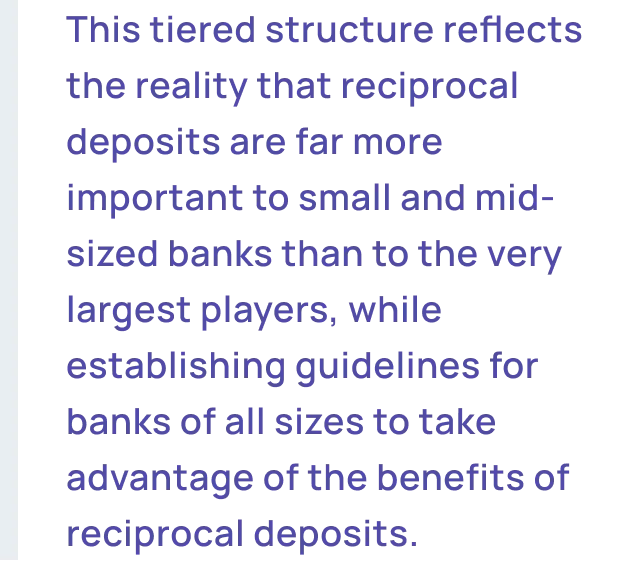
This tiered structure reflects the reality that reciprocal deposits are far more important to small and mid-sized banks than to the very largest players, while establishing guidelines for banks of all sizes to take advantage of the benefits of reciprocal deposits.
Eligibility for non-brokered treatment is limited to banks with CAMELS ratings of 1, 2, or 3, ensuring that only healthy, well-managed institutions can participate. At the same time, the bill preserves the FDIC’s complete oversight of reciprocal deposits, providing regulators with continued visibility and control.
What is appealing about this new proposal is that by expanding access to a broader range of banks, it supports a market-based solution that enables banks to implement at their own discretion, based on the needs of their own individual bank, business model, and customer base.
Why H.R. 3234 Matters for Banks Today
The urgency behind H.R. 3234 is clear. The 2023 failures of Silicon Valley Bank, Signature Bank, and First Republic demonstrated how quickly uninsured deposits can move in periods of stress, regardless of their regulatory classification. Billions of both core and brokered deposits moved within hours, often to the nation’s largest banks, demonstrating how fragile confidence can be when deposits are uninsured and sit above the FDIC insurance cap. The focus quickly became whether or not funds were insured.
For banks, that moment reinforced the importance of principal protection, driving demand for insured capacity beyond the current $250,000 cap among retail customers, as well as corporate treasurers, municipalities, and institutional clients. Without a solution, those balances would either need to be collateralized, insured privately at a significant cost, or lost to larger competitor banks perceived as safer.
By expanding the classification of reciprocal deposits, the Keeping Deposits Local Act would provide banks with more flexibility to meet those expectations and a means to retain valuable deposits. The Act aims to position reciprocal deposits as a tool to enhance customer protection and system stability, keeping funds within the banking system as regulators continue to study deposit behavior and stability to inform future supervisory approaches.
If passed, the bill will reshape how reciprocal deposit networks fit into funding strategies and customer conversations.
Implications for Banks
-
Capacity:
Expanded thresholds mean banks can keep a larger share of customer balances insured without pledging securities or obtaining surety bonds while maintaining the same level of deposit funding. This change allows institutions to serve municipalities with multimillion-dollar payroll accounts or businesses with sizable working capital deposit accounts without losing those relationships to larger competitors or depleting excess collateral.
-
Compliance:
The CAMELS requirement underscores that only healthy, well-managed institutions will benefit. Banks will need robust reporting and audit processes to demonstrate eligibility and manage reciprocal balances in accordance with FDIC oversight.
-
Competition:
By leveling the playing field, H.R. 3234 strengthens the ability of small and mid-sized banks to compete with GSIBs for important commercial and municipal accounts profitably, as well as expanding their opportunity to support wider lines of business, including escrow accounts and partner banking relationships. Keeping these deposits local supports not only customer retention but also credit availability for small businesses and local projects.
-
Perception:
The Federal Reserve’s April 2025 Financial Stability Report cautioned that, “While reciprocal deposits are fully insured, they are more expensive than traditional core insured deposits and may not be as stable during times of stress.” Despite this, for many banks, having access to contingency funding through reciprocal deposits can mitigate volatility risks from brokered deposits. Banks that utilize the new thresholds will need to demonstrate how diversification, risk controls, and data-driven management make these deposits a stable component of their funding base.
Industry Support for H.R. 3234
The Keeping Deposits Local Act has drawn unusually broad support across the banking sector. The American Bankers Association (ABA), the Independent Community Bankers of America (ICBA), and numerous state associations have all endorsed the measure. That alignment reflects a shared view that participation in reciprocal deposit networks is an essential tool for smaller banks competing with the largest institutions.
On Capitol Hill, the bill has picked up bipartisan momentum. Policymakers on both sides of the aisle recognize that stabilizing the deposit base of community and regional banks is a public good. On September 16, 2025, the Financial Services Committee advanced H.R. 3234 by a unanimous vote of 51-0, saying, “This bill would allow community banks who often have small branch networks to accept a greater amount of reciprocal deposits before becoming subject to stringent brokered deposit regulations, helping them make loans in their local communities.”
This reform also fits into a broader conversation about the future of deposit insurance. The FDIC has acknowledged that in an era when deposits can move at the speed of a tweet, deposit insurance frameworks must evolve. H.R. 3234 represents a targeted and practical step toward expanding reciprocal deposits while maintaining full FDIC oversight.
The Future of Reciprocal Deposits Under H.R. 3234
Reciprocal deposits are no longer a gray area in regulation. With the proposed Keeping Deposits Local Act, Congress is signaling that they are becoming a core part of deposit stability.
For banks, this reform presents both opportunity and protection. It expands the ability to retain valuable customer relationships while also reducing the risk of sudden deposit flight by converting large uninsured balances into insured deposits. Customers also benefit, knowing their funds can continue to have access to FDIC insurance while staying with their local institution.

The Dallas Fed has suggested that risk-based deposit insurance premiums could eventually favor reciprocal deposits, reflecting their role in reducing the concentration of uninsured balances.
If passed, H.R. 3234 would change how banks approach large deposit relationships. Participation in reciprocal deposit networks would transition from a niche workaround to a mainstream funding strategy, from an optional tool to a policy cornerstone. That outcome would be widely beneficial for banks, customers, and the resilience of the U.S. financial system.